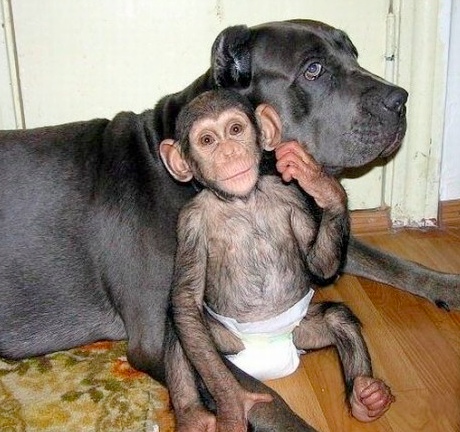
I’ll probably never know the full story behind this — and it has nothing to do with the things we normally talk about around here — but it was too amazing not to share.
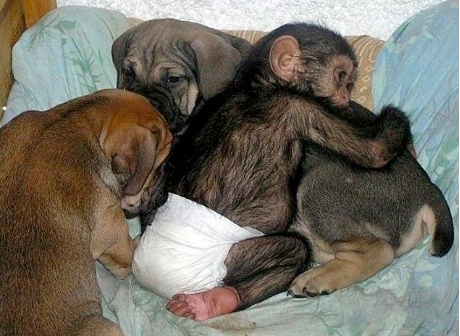
After a mother chimp died at a zoo, one of the zookeepers brought her baby monkey home in order to care for it. The employee’s dog had just had puppies. Unexpectedly, the mother dog bonded with the baby chimp and the chimp ended up seeing the puppies as his siblings. You’ll find nine pictures on this page. I’ve included a couple just to give you an idea. If you love dogs — or chimps — you’re going to love this.
If anybody happens to run across the full story, such as where this happened, I’d love to update this.
Note: I still haven’t found anything definitive about this, but Jeremy Barger found a link with a slightly different version of the story. According to that version, it happened two years ago at a Russian zoo and the chimp’s mother had rejected him instead of having died. It’s hard to say which version is correct.
 Taxing ‘the rich’ more not only wouldn’t work, but it’s not fair
 I don’t like most people in TV ads, but I can’t tell if it’s them or me
 X-ray scanners used by TSA banned in Europe over health concerns
 Living without human connection? It’s an empty life with no meaning
 Women, you perpetuate this by reproducing with these lewd jerks
 Today’s group hatred says world hasn’t learned Auschwitz lessons
 After his death, I can finally see good in narcissistic father again
 In ’98, Ron Paul warned U.S. policy was leading to terrorist attacks