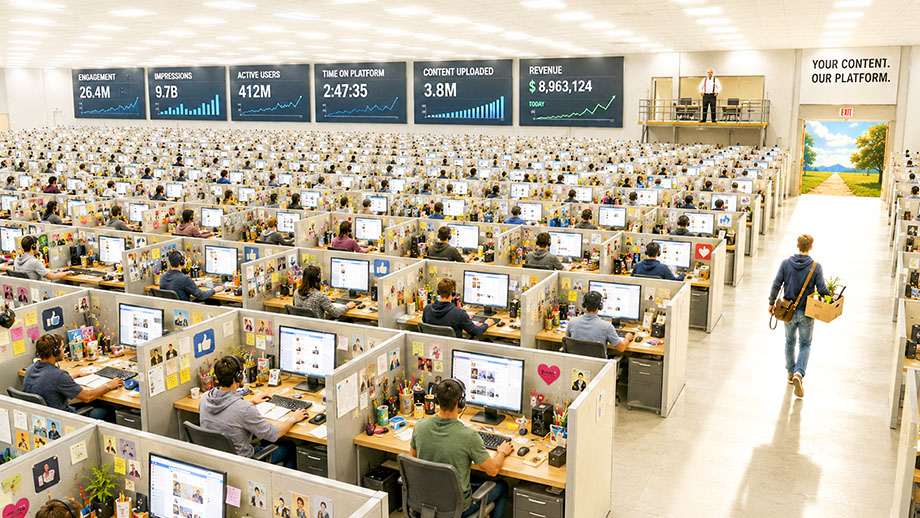
Would you apply for this job?
HELP WANTED: Profitable and successful tech company is looking for workers to create all content for its media platforms. Applicants can create as much as desired, but company will determine which content is used and which is ignored. Company has strict content rules and workers can be banned or punished with no warning or recourse. No compensation is offered except to the most popular creators, but think of the exposure. Join our company today.
Unless you’re an idiot or a masochist, you wouldn’t apply for that job. I wouldn’t, either. I would laugh at it and mock the intelligence of anybody who would fall for such a one-sided deal.
But when I’m honest with myself, I realize that’s what I’ve been doing for years on social media.
I started joining social media platforms — Facebook, Instagram, Twitter and even Threads — starting in about 2007. The value proposition was simple: You connect with your friends and anybody else you want to connect with. Your friends will be shown everything you post. You’ll see everything they post. And there’s no charge for this. What a deal.
As the social media companies grew more popular, they changed the deal. They introduced algorithms which determined which tiny portion of your posts would be shown to your friends. Then the companies started randomly showing you posts you never asked for — from people you’ve never heard of, about things you don’t care about.
But we put up with it, because we had developed a weird addiction to social media. We created all of the editorial content for companies which have gotten fabulously wealthy. We’ve been bewildered sharecroppers on a digital plantation.
Today, I’m starting the process of walking away from all of that. This is not what I signed up for.
 Actions more important than words when judging what someone wants
 Do people change? Or do we just learn how to manage our faults?
 FRIDAY FUNNIES
 Healthy partner will always ask, ‘Who do you really want to be?’
 Unjustified panic: Why are you so scared of all the wrong things?
 Watching a friend’s happy family makes me feel pangs of jealousy
 Modern life doesn’t have to be as complicated as we try to make it
 Slow death of painful past leaves me trapped in fog of depression
 Nearly half of U.S. households now get subsidies from the rest of us