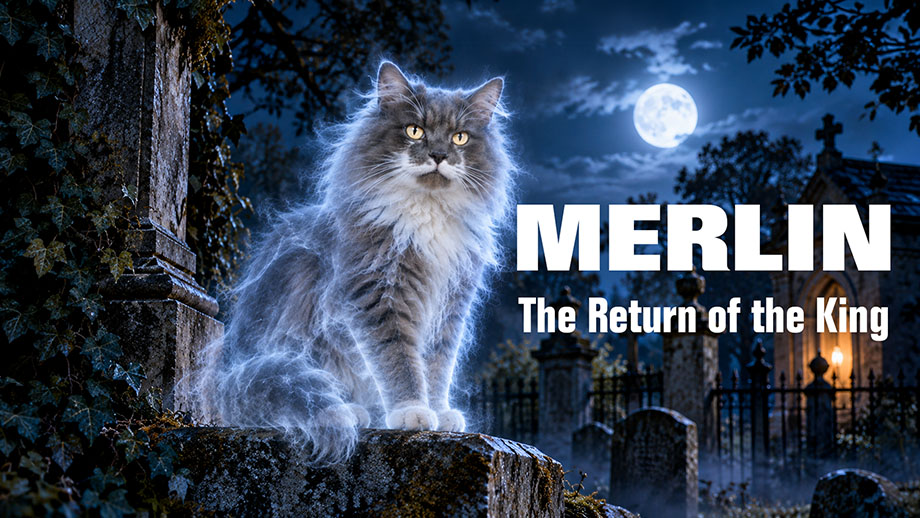
I made a few fun images over the weekend of my current cats as Halloween characters. Alex was a vampire. Meg was a spell-casting witch. And Oliver was originally a ghost, since his light gray fur seemed appropriate for that.
But as I tried to get to sleep Sunday night, it suddenly hit me that I needed to make a Halloween short about one of the cats I’ve lost as a ghost. And as the “alpha feline” of all time in my house, Merlin was the obvious choice.
So this is a one-minute short that I enjoyed creating Monday.
I started with original photos of Merlin and then designed scenes in a spooky mansion for him to roam as the home he was reclaiming. OpenAI’s image generator then helped me make reference images of those scenes and I edited them in Photoshop
The scenes were animated — in very rudimentary ways — through a video service called Runway. I wrote the script and had the narration created in ElevenLabs. The music came from Soundstripe, which is the service I use for all my music needs.
The titles were created in Photoshop and then everything was assembled in iMovie on my MacBook. (This was simple enough that Final Cut Pro would have been overkill.)
I had great fun making it, so I hope it will make a few people smile. And if the moon is full for Halloween this week, don’t be surprised to see Merlin back for a visit.
 Obama’s delusion about ‘explaining’ illustrates all-too-common narcissism
 Why do we paint ourselves into joyless corners with no way out?
 How could we take responsibility but avoid self-destructive shame?
 Taking responsibility for mistakes is foreign concept in many lawsuits
 Kitten outsmarted me for weeks, but Alex finally joined our family
 Hearing voice of the one you love can be medicine for hurting heart
 Rhetoric about freedom means nothing without right to secede
 Rational rules don’t apply when the state gives itself a monopoly
 As world descends into madness, back away and guard your heart