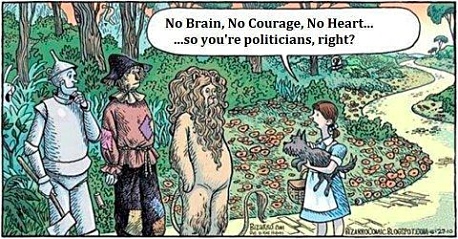
Dorothy knew things were bad when the twister carried her away from Kansas, but she suddenly understood just how bad things really were when she realized what her traveling companions really were.
making sense of a dysfunctional culture
Dorothy knew things were bad when the twister carried her away from Kansas, but she suddenly understood just how bad things really were when she realized what her traveling companions really were.
Why has the modern educational establishment become so obsessed with standardized testing and uniformity of measurement? When did so many people start believing that you could plot learning as numbers and graphs — and still teach children what they need to know?
That’s what I kept thinking as I read about a $1.1 million project to look into designing “galvanic skin response” bracelets for students to wear that would measure their degree of engagement with what they were listening to. The goal is to find out whether physiological feedback from these sensors could tell teachers whether students are learning or not.
If you’re not familiar with the phrase “galvanic skin response,” it’s just the name for the process of measuring how electricity flows through the skin depending on changes in moisture. It’s the principle upon which so-called lie detectors work. (Those things are bogus, but that’s another story entirely.)
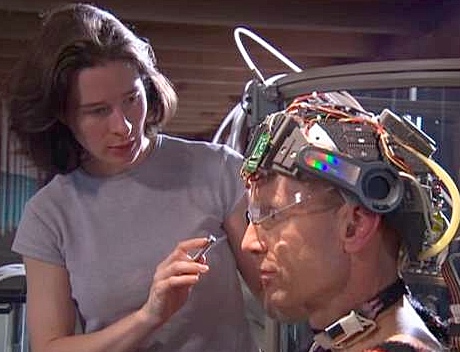
Is this really the way some people believe we should decide whether kids are learning? Are we going to keep going until we strap a sensor helmet on kids every morning so we can monitor their thoughts for the full day?

If you plan to spend any time in Middleborough, Mass., you might want to be careful if you’re the sort who enjoys slinging four-letter words around. The town’s residents voted 183-50 Monday night to enact a fine for the public use of profanity, so police will have their ears open.
In modern American society, this is typically seen as a conflict between free speech and civility. Some people believe you should be able to say anything you want without government interference, and others believe that offensive and vulgar behavior should be prohibited. Merchants in the town say some of their customers have been uncomfortable with groups of teens hanging out downtown and swearing loudly. So which side is right?
I’m an advocate of keeping government completely out of the business of censoring speech, but I’m also someone who detests profanity. (I’m one of the few people you know who you’ll never hear it from. I didn’t grow up with it and I’ve consciously avoided using it. It’s not what I want to be.) So it sounds as though these two competing values are in conflict and there’s no logical way to resolve it.
That’s sort of true. There’s no logical way to resolve it under the current system of “public” ownership of property and the rules that come with “public” space. But what if the real issue isn’t free speech vs. civility? What if the real issue is who owns property — and who should be allowed to make the rules?
 Once again, here’s a reality check: Masses don’t want libertarian ideas
 Without community, we no longer know each other, in life or death
 Federal debt default? So what? It happened before — in 1979
 If elections could bring freedom, voting would have been outlawed
 Is Obama playing politics with war on terror? Of course, just as Bush did
 Rush Limbaugh is just as partisan and ignorant as MSNBC’s Ed Schultz
 I’ll never really know my mother and I’m envious of those who do
 Media bias: ‘They can state the facts while telling a lie’
 That huge fed debt increase? They’ve already used 60 percent of it