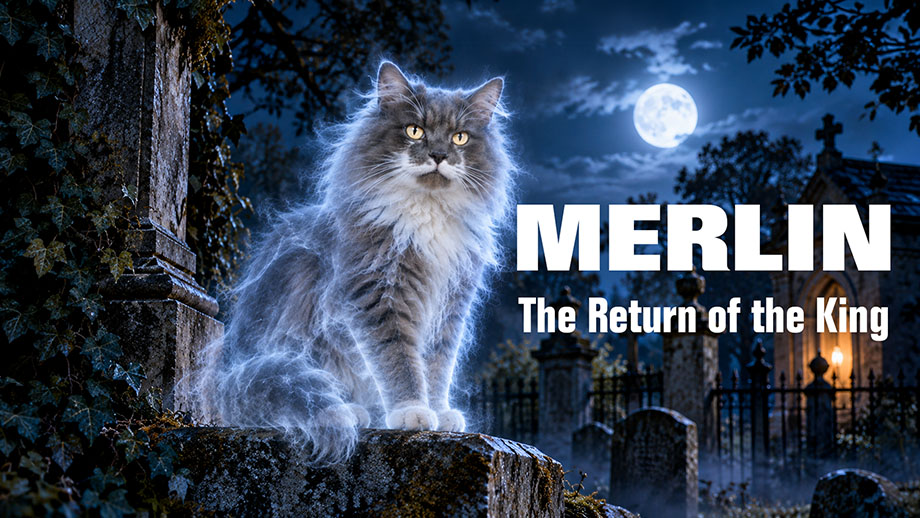
I made a few fun images over the weekend of my current cats as Halloween characters. Alex was a vampire. Meg was a spell-casting witch. And Oliver was originally a ghost, since his light gray fur seemed appropriate for that.
But as I tried to get to sleep Sunday night, it suddenly hit me that I needed to make a Halloween short about one of the cats I’ve lost as a ghost. And as the “alpha feline” of all time in my house, Merlin was the obvious choice.
So this is a one-minute short that I enjoyed creating Monday.
I started with original photos of Merlin and then designed scenes in a spooky mansion for him to roam as the home he was reclaiming. OpenAI’s image generator then helped me make reference images of those scenes and I edited them in Photoshop
The scenes were animated — in very rudimentary ways — through a video service called Runway. I wrote the script and had the narration created in ElevenLabs. The music came from Soundstripe, which is the service I use for all my music needs.
The titles were created in Photoshop and then everything was assembled in iMovie on my MacBook. (This was simple enough that Final Cut Pro would have been overkill.)
I had great fun making it, so I hope it will make a few people smile. And if the moon is full for Halloween this week, don’t be surprised to see Merlin back for a visit.
 Learning to be an emotional man helped me to overcome numb past
 ‘Curing’ unpopular beliefs through psychiatry is throwback to ugly past
 Aren’t you thankful for the right to vote before they take your money?
 Birmingham man offering $10,000
 Will you sell more days of your life
 Little remains in me of the person I was when I married for lifetime
 If we’re seduced by our desires, we often follow devil in disguise
 Why do we consider it shallow to crave beauty in romantic partner?
 Do you believe you’re free? Slavery by any other name is still slavery