When I first heard about the shooting at a high school in Ohio Monday morning, my mind immediately went back to the shootings at Columbine High School near Denver almost 13 years ago. I wonder if this incident will ignite the same hysterical reaction as the one that followed the Columbine tragedy.
In the shooting at Chardon High School, just outside of Cleveland, a lone student apparently came to the school cafeteria Monday morning and fired four or five shots. The student was someone who other students described as an outcast, someone who might have been the victim of bullying.
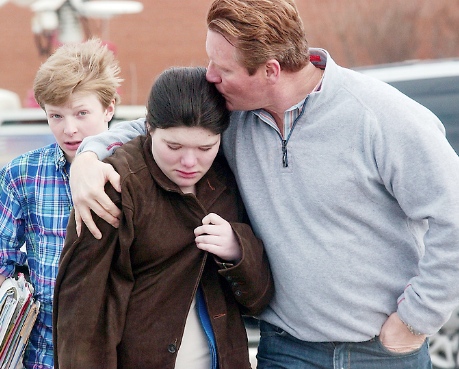
Roughly 1,200 students and their parents spent the rest of the day being grateful they weren’t directly affected by the shooting — such as the student and her father above — but a few families weren’t so fortunate. Two students died and three others are wounded.
After the Columbine shooting in 1999, there was a renewed push to make guns harder to own. There was also a huge and very expensive push to install metal detectors and upgrade security at schools all over the country. Schools that had been relatively open to their communities because more like fortresses in some cases. Why? Because every administrator was scared that his school system might one day be the site of another random fluke of violence — so every one of them went overboard to show parents that everything was being done to protect their children.
 The Alien Observer: The Outrage Machine is destroying us all
 Lesson of ‘judgment day’ error? Certainty doesn’t indicate truth
 Demographic trends setting U.S. up for race wars in coming decades?
 Far-left political idiocy is ruining remake of Disney’s ‘Snow White’
 If you participate in sham of voting, you’re responsible for what it creates
 Tradeoffs about values leave me feeling like ‘double-minded man’
 Is ‘majority rule’ moral even when the majority don’t want freedom?
 Lack of ability to think plays a role in public acceptance of higher taxes
 Years later, Supreme Court justice apologizes to Susette Kelo, sorta