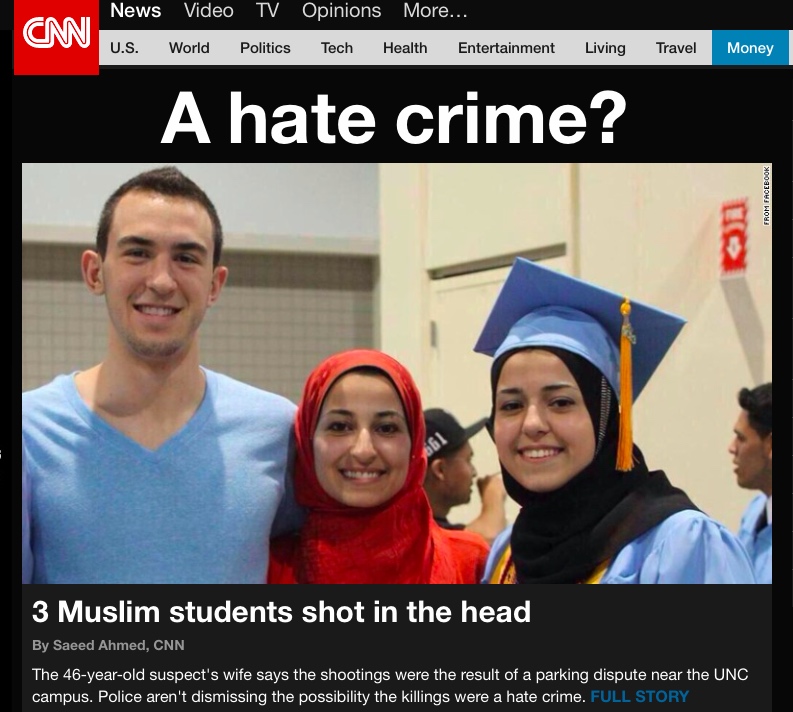
When three college students in North Carolina were murdered Tuesday night, it was a tragic story for their families and friends. Now CNN is throwing its resources into turning these murders into “hate crimes.” If there are any honest journalists left who work for CNN, I hope they’re still self-aware enough to be ashamed of their employer tonight.
This is a screenshot of the lead story on CNN’s website for most of the day Wednesday. (Click it for a full-size version.) I’m so disgusted by the manipulation and poor ethics of this graphic that it’s hard to know where to start. But let’s look at it quickly anyway.
We’ll start with the hammer head above the photo: “A hate crime?” Most of the time, when a news story has a question mark, it means, “This is what we want to believe, but we don’t have the facts to say it, so we’re just going to imply it.” In an opinion piece, there’s nothing wrong with it. Even in some news stories in which there’s legitimate mystery, it might be acceptable. But it is always a violation of ethics to place your own unsupported agenda into a headline and then use a question mark to weasel out of taking responsibility for what you’re claiming.
 All offers eventually expire, so do your best to ‘come before winter’
 Ocasio-Cortez and Trump just like characters in ’75 satire ‘Network’
 How we live our lives can allow us to redeem dark family history
 I was agonizingly slow to ‘get it,’ but the joy of music changed me
 Inner peace requires breaking free of your defense mechanisms
 Looking at old photos reminds me of success I once took for granted
 ‘All animals are equal, but [deaf] animals are more equal than others’
 Words of appreciation can have power to connect us and heal us
 Best years of our lives? For me, teen years were start of feeling like alien