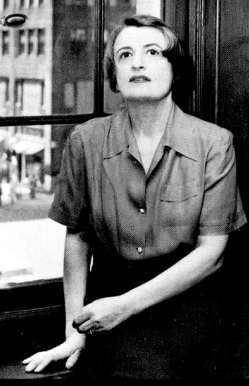
 If Ayn Rand knew how closely she has become identified with libertarians, she would be spinning in her grave. She loathed libertarians, calling them “hippies” of the New Right.
If you read her comments about libertarians — at the website of the Ayn Rand Institute — you quickly see that Rand didn’t understand any system that could do away with the coercive state. You also suspect that she was a bit jealous that libertarians were getting too much publicity, as she sniffed that they were “stealing” and “plagiarizing” some of her ideas.
I read several of Rand’s books before I ever heard the word “libertarian.” When I was about 14 or 15 years old, my father’s boss gave me a copy of “Anthem.” When I liked that, he recommended “The Fountainhead” and “Atlas Shrugged.” Her books introduced me to many new ideas, some of which I accepted and some of which I rejected. I consider reading those books important in my later political development, even though I reject the core of her philosophy.
And that’s one of the most interesting and complicated things about Rand. Almost everybody I know who has read her books has rejected her philosophy — which she called objectivism — but most of the readers of those books who went on to become libertarians or anarchists consider her work to have been an important step along the way, even though they did reject what was most important to her. How do we reconcile this seeming contradiction?
 Hey, you! If you’re in New Jersey, you help pay for ‘Jersey Shore’
 When times turn too dark in my life, I’m grateful for furry antidepressant
 Double standards seem like the only standards most politicians know
 Little blonde cousins are sometimes perfect antidote for life’s bleak days
 Spooky stories: My friends share their real-life weird experiences
 Happiness and success elude me unless I’m doing something I love
 THE McELROY ZOO: Meet Sam, the baby kitten I stole
 I’d like to help change the world, but politics is no longer my hobby
 Hearing what your gut whispers might save you from wrong path