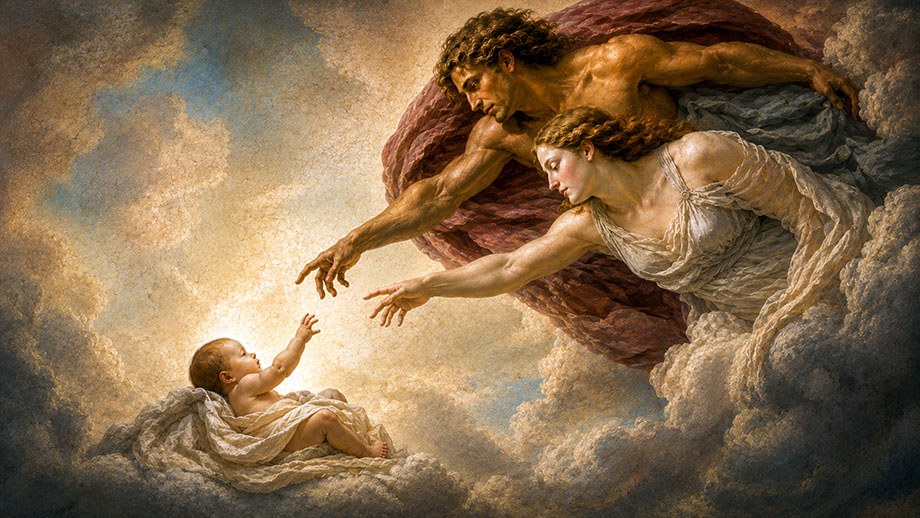
Every time I hold a newborn baby, I’m filled with wonder — because each new life feels like a miracle.
We don’t like to talk about miracles today. Rational materialists laugh at the idea that miracles can happen. Even Christians draw a line between the “supernatural” and things we choose to accept as normal. Some of us would rather not talk about anything that science can’t explain.
But the longer I live, the more I’m forced to accept that there are plenty of truths that nobody can explain. Life and love are ordinary miracles. We might accept that they’re real, but we have no more explanation of them than we have of how Jesus might’ve turned water into wine.
Our lives are filled with ordinary miracles. In fact, the best parts of our lives are those inexplicable things that don’t have natural explanations. Those things are far more impressive than the supernatural miracles that so many people try to find.
It’s as though we’re so accustomed to these tiny miracles that we pretend we understand them.
Science can tell you what happens as new life is created. We understand the process. We know that an egg has to be fertilized and it might grow into a new human life.
But we are utterly incapable of creating that life on our own. The most ignorant people can create life using the natural processes of nature, but the most brilliant and scientific mind is incapable of creating a human life without combining bits of life that nature has already created.
Love is a miracle. We can’t see it. We can’t touch it. We can’t prove it exists.
Yet everyone knows that this miracle is real. At some point in his or her life, every human has experienced it to one degree or another. And even if we don’t understand it — what it is or where it comes from — we know that we need it, for reasons we don’t understand.
Human consciousness is perhaps the greatest miracle of all.
Scientists can study the electrical impulses moving through the brain. They can identify which parts of the brain are active while we think, fear, dream and love. They can document chemical reactions and biological processes.
But nobody can explain why we’re conscious at all.
Nobody can explain why a collection of atoms somehow became self-aware and capable of experiencing beauty, grief, joy and meaning. Nobody can explain why music can move us to tears or why human beings willingly sacrifice themselves for people they love.
(Yes, Dawkins can postulate that “the selfish gene” explains everything, but it’s just another story to explain something that we don’t understand.)
We simply accept these things because they happen around us every day.
But if a man walked on water, people would call it a miracle because it violated their understanding of nature. Somehow, the existence of self-aware life capable of love, creativity and moral thought seems less miraculous to us simply because it happens constantly.
Familiarity has made us casual about wonders.
We’ve become so accustomed to extraordinary things that we no longer see them as extraordinary.
Every person reading these words is a conscious mind somehow emerging from unconscious matter. Every person carries invisible emotions, memories, fears, longings and affections that cannot be physically touched or measured in any complete sense. Every person who has ever deeply loved another human being has experienced something that transcends mere chemistry, even if chemistry is involved in the process.
And despite all our scientific advancement, we still cannot fully explain what consciousness is, where love comes from or why beauty affects us so deeply.
We can describe processes. We can observe patterns. We can identify mechanisms.
But description is not the same thing as understanding.
The modern world tends to imagine that mystery disappears once a process can be described. But that isn’t true.
Knowing how a sunrise occurs does not make it less beautiful and it doesn’t explain why it’s beautiful. Knowing how the human brain functions does not explain why we experience wonder. Knowing how reproduction works does not explain why a newborn child feels miraculous when you hold him or her in your arms for the first time.
In some ways, we seem determined to search for miracles only in spectacles — in signs from heaven, supernatural events or violations of what we have defined as natural law.
Meanwhile, ordinary miracles quietly surround us every day.
A new life.
A human consciousness.
Love that cannot be measured.
Beauty that serves no practical purpose.
The strange and inexplicable reality that any of us exist at all.
Perhaps the greatest miracle isn’t that extraordinary things happen once in a while. It’s that we’re surrounded by astonishing realities that we’ve slowly learned to treat as ordinary.
I’m not going to argue about religious miracles. If you don’t believe, I completely understand. If you choose to believe the stories found in your own religious tradition, that doesn’t bother me, either.
But the universe has never stopped being miraculous.
We’ve simply become so accustomed to some of life’s greatest wonders that we rarely stop to notice them anymore.
New life.
Consciousness.
Love.
Beauty.
The strange reality that anything exists at all.
These things may be ordinary, but they deserve our reverence all the same.
 Memo to politicians: Coercion isn’t the same thing as ‘investment’
 Search for new partner leaves me wondering where she’s waiting
 Moral priorities: ‘If we free the slaves, who will pick the cotton?’