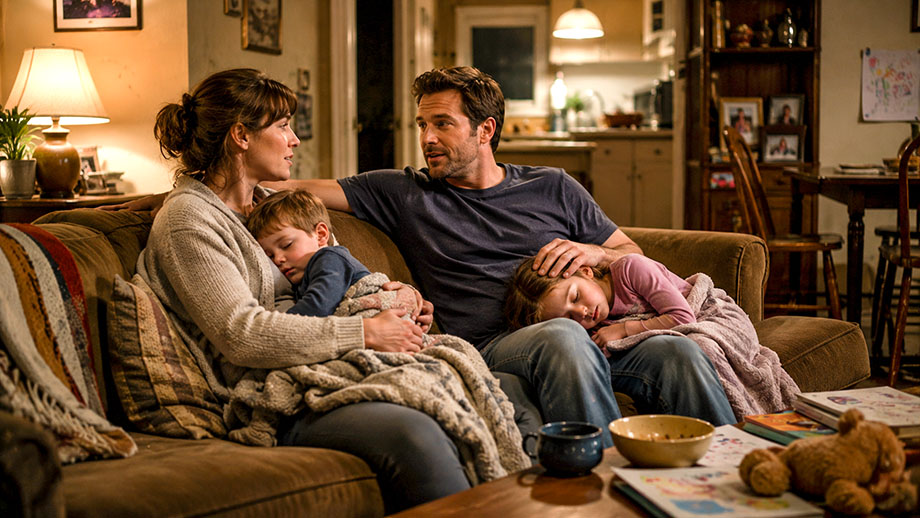
A baby isn’t born with an owner’s manual.
Human beings are born into all sorts of circumstances. Some come into loving homes. Some face challenges that make life confusing.
When children are young, they’re under the control of adults who seem god-like in many ways. The adults seem to know everything. They seem to have complete control. We eventually figure out that those adults are typically just as confused as we are, but in the meantime, we absorb everything those adults teach.
Some of what we’re taught is intentional, but much of it is what we pick up from the examples around us. Both good and bad.
By the time a child is in the neighborhood of 18 years old, he or she is considered an adult. The child has spent years trying to define himself or herself in relation to parents, assuming those figures are around. At first, most children want to be just like their parents, but the time soon comes when they want to pull away and live their own lives.
By the time I was in my 20s, I knew everything. Or so I thought. I really thought I had everything figured out. Most people feel the same, either consciously or unconsciously. And then we’re off to building a life as a new adult.
But in all of that messy process, one thing is true for almost all of us. Since we don’t have an owner’s manual, we’ve been programmed by parents and preachers and teachers.
Nobody has ever told us that we need to ask one basic question: How should I live a good life?
That sounds mundane, but it’s not.
Culture invisibly brainwashes us about what a good life is. Parents and preachers and teachers can modify that programming, but people living in a media-centric age absorb the vast majority of what they believe — about the world and about themselves — from that media culture.
It’s very difficult — and very rare — for a typical young person to question what he or she has been taught. So the question of what constitutes a good life — and how this particular individual ought to live — is rarely asked in a serious manner.
You basically have two broad approaches.
One approach is down the path of inherited answers. The other approach leads down a path to consciously chosen answers.
You can select the off-the-shelf package of answers that your culture gives you. You can accept those answers and maybe modify them a little bit to suit your purposes.
Or you can reject what the culture gives you and you can design your own answers for your own life.
The first path is the default choice for everyone in our culture. It’s the path of least resistance. Since everyone else is doing it — copying the norms that are presented in movies, television, music and social media — that seems like the obvious right choice.
For most people, it’s not even a choice. It’s just the only obvious reality.
But when you look around in our current dysfunctional culture and see how miserable the average person is today, it seems far more reasonable to reject what the culture is selling and ask yourself that simple question.
How should I live a good life?
You have a limited number of years and days and hours. You don’t know exactly how many, but you can pull a number out of the air. Let’s say you’re going to live 90 years.
If that’s the time you have, how do you need to invest those years in order to be able to look back at the end of them and feel as though you lived well?
If you follow the path that’s programmed into you by your culture, you will spend most of those years chasing things that the culture tells you are important. You will pursue money, possessions, prestige, pleasure and ego-satisfaction.
Those pursuits are incredibly time-consuming. Look at the people around you. How many do you see on an endless treadmill that promises those things will eventually show up if they run harder and harder?
How many do you know who would like the time to pursue more important things — happy families, spiritual development, more loving connections — but who never quite get around to it? How many do you know who are so exhausted from living a “normal life” that they never quite find the time to give more than lip service to something deeper in life?
Here’s the thing. Living the way the world teaches you to live is time-consuming. Living the way a wiser person might live is also time-consuming.
The brutal truth is that you can’t do both.
If there were an owner’s manual for a human being, it would teach us this. It would explain that the money and pleasure and possessions are going to seem pretty empty and sterile if we allow those things to dominate our lives.
Such an owner’s manual would explain that in order to have the things which will ultimately matter in life — love, spiritual riches, close connections to others — we have to sacrifice much of what the culture tells us to chase. Actually, the longer I live, the more I think we have to reject pretty much all of what the culture tells us to chase.
The most powerful teacher I have had in life has been failure.
When I was young, I wanted to be wealthy and powerful. I wanted money and success and public adulation.
The older I got, the more I saw how little those things mattered to me. But I was able to notice that truth simply because I had moments of intense failure — when I was forced to look myself in the mirror and ask myself what really mattered.
I can’t tell you exactly what should matter to you. I’ve been bold enough — maybe even arrogant enough — to write quite a bit over the years about what can contribute to a good life. I think I have some powerful reasons and some powerful evidence in favor of the conclusions I’ve drawn.
But whether you agree with all of my conclusions or not, I think it’s inarguable that the path presented by our culture is spiritually bankrupt. It’s a cruel path that leads to a wasted life.
I’ve been hard-headed about giving up all that I was brainwashed to believe.
I wanted to hold onto the notion that I could sit on the fence, one foot in each world. I wanted to believe that I could have a good bit of what the culture offers to me and still have the time and energy to pursue things that mattered more deeply.
It’s only been in the last few years that I’ve given up on the lies I was taught.
I no longer care about the things the culture thinks matter. I spend more and more of my time doing things that truly matter to me. I no longer feel the need to justify my choices. I no longer feel ashamed of saying, “No, I don’t want the things you have in your life — not because they wouldn’t be nice to have, but because the price is too high.”
I wish I had had an owner’s manual to teach me these things when I was young. I like to think I would have listened, but maybe I’m fooling myself.
Either way, I understand now what matters. And what doesn’t matter. I’ve re-arranged my life to give the years and months and days that I have left to the things I believe genuinely matter.
Your conclusions about what actually matters might end up differing from mine. That’s fine. There’s nothing magical or infallible about my own conclusions.
But I’m begging you not to take the unthinking default choices offered by the culture. I’m begging you to ask yourself — in a very serious way — what it would take for you to live a good life.
 Dogs, cats and children remind me of all the joy in small things
 Here’s the jobs growth Obama promised—in federal workers
 Star Trek film is reminder that adults no longer run Hollywood