• Skip to primary navigation
  • Skip to main content
  • Skip to primary sidebar
  • Skip to secondary sidebar
  • Email
  • Facebook
  • Instagram
  • YouTube

David McElroy

making sense of a dysfunctional culture

  • About David
  • New here?
  • Reading
  • Video

Making good art is really hard; getting paid for it is even harder

By David McElroy · July 1, 2026

Almost anyone can type. Some of those people can write and think clearly enough to shape a coherent story. A tiny fraction of those do it well enough to get a good novel published.

Anyone can splash paint onto a canvas. Even if you have no talent for illustration or composition or brush strokes, you can make painted shapes and call it modern art. A tiny fraction of those can convince critics that their work should be sold in galleries.

It’s true for every field of art. With the tools that are readily available today, almost anyone can make a creative project — a film, a sculpture, a photograph, a book. A few of those will be really good.

It requires talent and work and patience and luck to produce something that most people would see as art. It’s incredibly difficult. It’s something many people spend a lifetime trying to do.

But as difficult as those things are, it’s even harder to earn a living today with art.

For some people, it’s simply because their work isn’t good enough. But even many people who produce excellent work can no longer make a living from the art they most want to create.

The world has changed in ways that make things very hard for creative people today. I don’t like the changes. I’ve ranted about those changes and been angry about them, as have many creators.

But the media world of the past is gone. It’s not coming back. For me, that means I have to change. It’s time for me to stop fighting reality.

The media world didn’t change because a handful of executives got together in a smoke-filled room and decided to make life miserable for artists. It changed because technology changed. Every major advance in communications technology has reshaped the way creative people reach an audience.

The printing press changed literature. Photography changed painting. Radio changed music. Television changed politics and entertainment. As Neil Postman argued years ago, every medium changes not only what we communicate, but how we communicate. The internet didn’t interrupt that process. It accelerated it.

For generations, creative people lived in a world controlled by gatekeepers. Book publishers decided which authors would be printed. Record labels chose which musicians would be promoted. Film studios determined which scripts would become movies. Newspaper and magazine editors decided which writers would be published. Galleries chose which painters deserved to have their work shown.

Those gatekeepers were often wrong. They overlooked talented people, rewarded mediocrity and sometimes confused fashionable work with meaningful work. But for better or worse, they were human beings exercising human judgment.

Today, most of those gatekeepers have either disappeared or become dramatically less important. Almost anyone can publish a book, release an album, upload a film, display photographs or publish essays for the entire world to see. The barriers to creating and distributing art have largely collapsed. At first glance, that sounds like an extraordinary victory for creative people. When it first started happening, I expected it to lead to a creative renaissance.

The problem is that removing gatekeepers didn’t remove gatekeeping. It simply replaced human judgment with social media algorithms —

Algorithms don’t ask whether a novel is profound or a photograph reveals something true about the world. They don’t wonder whether a song will still matter 20 years from now or whether an essay might quietly change someone’s life. Their purpose isn’t to identify significance. It’s to maximize engagement. They reward whatever keeps people scrolling, clicking, commenting and watching for a few more seconds — because that’s how advertising platforms make money.

That subtle change has enormous consequences. Instead of editors making imperfect decisions about what deserves an audience, algorithms increasingly reward whatever captures attention most efficiently. Outrage outperforms reflection. Familiarity outperforms originality. Quantity outperforms craftsmanship. The result isn’t that good work has disappeared. It’s that good work has become increasingly difficult for the people who would value it to discover.

For artists, writers, filmmakers and musicians, this changes the economics of everything. Producing excellent work is no longer enough. Increasingly, success depends upon understanding platforms whose priorities have almost nothing to do with artistic quality. That’s a game many creative people were never interested in playing, yet it has become one of the primary ways audiences discover new work.

I don’t think this new reality is going away. I wish it weren’t true, but wishing doesn’t change what’s true. The media world I grew up in has largely disappeared, and no amount of complaining will bring it back. I can spend my time resenting what has happened or I can begin asking a much more useful question.

What opportunities exist today that didn’t exist before?

That question leads somewhere surprisingly hopeful.

For years, artists dreamed of creating without asking permission. They wanted freedom from publishers, producers, record labels, galleries and editors who stood between them and the public. Ironically, we finally achieved much of that freedom at almost the exact moment the economic model supporting independent artists began to collapse.

That’s a genuine loss. But it’s also an extraordinary opportunity.

Today, I don’t need a publisher’s permission to write an essay. I don’t need a television network’s permission to produce a video and make it available to the world. I don’t need a magazine’s permission to publish photographs or an editor’s approval before sharing an idea. If I feel compelled to make something, I can simply make it.

The challenge has changed. It isn’t creating the work or making it available anymore. The challenge is helping the people who would appreciate it discover that it exists.

That problem is real. But unlike the old gatekeepers, it isn’t controlled by a handful of institutions deciding whether my work deserves to exist at all. Somewhere out there are people who will appreciate what I create. My task is simply to find better ways to connect with them. That may eventually happen through communities, subscriptions, patrons or entirely new models that haven’t yet been imagined.

Every major technological revolution has eventually created opportunities nobody could foresee while living through the transition. I have no reason to assume this one will be different.

In the meantime, I have another choice available to me. I can earn my living some other way and create the work that matters to me anyway. If the market no longer supports the kind of work I most want to make, that doesn’t mean the work shouldn’t exist. It simply means I shouldn’t expect the market to validate every creative decision I make.

Oddly enough, that’s a liberating realization.

Once I stop expecting the market to tell me what deserves to be created, I’m free to create the things I believe are worth creating. I can write the essays I think need writing. I can produce the videos I want to make. I can experiment, fail, learn and continue creating because the work itself matters to me. If an audience eventually finds it, wonderful. If patrons emerge, even better. But neither becomes the reason I create.

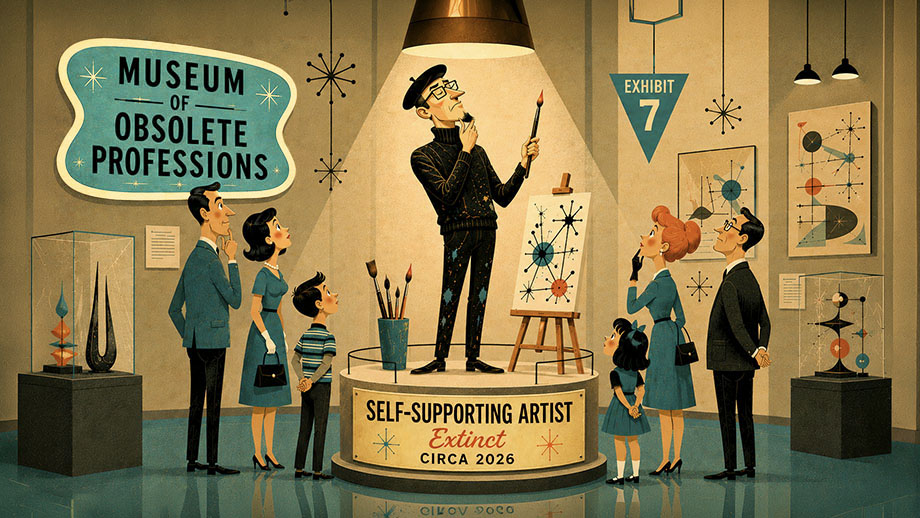
Perhaps the self-supporting artist is becoming an endangered species. If so, that’s sad. But the artist isn’t disappearing — and art isn’t disappearing.

People will continue painting, writing, composing, photographing and filming because human beings are creators by nature. The opportunity before us isn’t to recreate the media world that disappeared. It’s to discover what becomes possible in the one that has replaced it.

That seems like a much more interesting challenge than spending the rest of my life wishing it were still 1995.

Share on Social Networks

Related Posts

  • Before you can rescue other folks, you have to learn to save yourself
  • To think clearly, turn off the tube: Your television is not your friend
  • Pride can drive dumb behaviors, even if subject is just car lights

Filed Under: Uncategorized

Primary Sidebar

My Instagram

Donald Trump has figured out who to blame for the Donald Trump has figured out who to blame for the the D.C. Reflecting Pool turning green. The dastardly deed was carried out by a specially trained squad of Antifa cats trained by the Far Left. It’s not his fault. Arrest all the cats! #satire #parody
This was the sunset that faced me as I left Walmar This was the sunset that faced me as I left Walmart near my house just a few minutes ago. It was a beautiful light show for just a few minutes.
Here’s proof that reality and satire are indisting Here’s proof that reality and satire are indistinguishable these days.
This was the sunset I saw from the parking lot out This was the sunset I saw from the parking lot outside of the Walmart near my house just after the sun went down Friday evening.
This little parody was inspired by my trip to buy This little parody was inspired by my trip to buy gas a little while ago. Even at a no-name brand, the price was $4.09. If I remember correctly, it was $2.29 a gallon at the same station on the day the war started. I don’t know about you, but I’m tired of winning. 🤣
For the best and most sophisticated in lawn care, For the best and most sophisticated in lawn care, check out the sponsor of one of my upcoming YouTube video episodes. 🙃 #parody #threestooges
Have you felt as though you’re living through Grou Have you felt as though you’re living through Groundhog Day lately? Me, too. Here’s a quick-and-dirty political satire I made this evening for fun and stress relief.
About three minutes before sunrise, vibrant color About three minutes before sunrise, vibrant color is poking through the skies to the east of my back yard.
The lights and color might have been more spectacu The lights and color might have been more spectacular a couple of minutes before this, but this was the best view I had of the Monday afternoon sunset from a bridge over I-20 in Moody, Ala.
Follow on Instagram

Critter Instagram

Sam has come to hang out with me — in order to rem Sam has come to hang out with me — in order to remind me that his dinner is late.
How am I supposed to get any work done with all th How am I supposed to get any work done with all this Oliver fur all over my desk? 😺
The lighting was terrible here — since all the sun The lighting was terrible here — since all the sunlight is behind them — but I liked this short video of Sam giving Oliver a bath. It’s also very loud since I was standing right over an air conditioning vent that was blowing as hard as it could.
When I got home a few minutes ago, Alex wanted som When I got home a few minutes ago, Alex wanted some attention. He was purring loudly when I took this.
I’m happy to report that we’ve made it through ano I’m happy to report that we’ve made it through another day without squirrel attacks here at the house — all thanks to Sam’s vigilance.
I just got home and found Alex already starting to I just got home and found Alex already starting to campaign for dinner.
Sam takes his Neighborhood Watch duties far more s Sam takes his Neighborhood Watch duties far more seriously than most cats do, but the fact that the house hasn’t yet been attacked for squirrels is proof that his advanced methods work.
Right around sunset, Sam was in an office window w Right around sunset, Sam was in an office window when Oliver wanted to be there. So Oliver jumped into the window and crowded his little brother as though he was trying to intimidate him. But Sam stood his ground and Oliver eventually gave up and jumped back down — and Sam kept his spot.
Someone was at the house for about an hour to do s Someone was at the house for about an hour to do some work and now that he’s gone, the cats want some reassurance that their space isn’t being invaded.
Follow on Instagram

Contact David

David likes email, but can’t reply to every message. I get a surprisingly large number of requests for relationship advice — seriously — but time doesn’t permit a response to all of them. (Sorry.)

Subscribe

Enter your address to receive notifications by email every time new articles are posted. Then click “Subscribe.”

Search

Donations

If you enjoy this site and want to help, click here. All donations are appreciated, no matter how large or small. (PayPal often doesn’t identify donors, so I might not be able to thank you directly.)


Archives

Secondary Sidebar

Briefly

It turns out that the radical far left has been training “Antifa cats” to sabotage anything important to Donald Trump. Everything he did was perfect. Honest. It was all the cats’ fault. Arrest all the cats! This is the latest of my ridiculous satirical shorts. Please go watch it. Then “like” it and subscribe. Please. I’m begging you. (Too much?) Although a couple of the previous videos have had views in the hundreds, most have still been seen by fewer than 20 people. So I seem to be having trouble letting people know that page exists.

Here’s the latest of my ridiculous parody shorts. It crossed my mind Tuesday to wonder what a slick and fast-talking car dealer might do right now to try to turn the high price of gasoline to his advantage. So I conceived of a fat and lovable character who tried to sell cars that don’t use any fuel — and then I started wondering if it would be funnier if all the characters were felines. Designing the King Cashpaw character took about four hours, but the rest took only another four hours, so this was a relatively quick piece that virtually wrote itself. I know it’s almost impossible for these parody videos to find a larger audience, but at least they amuse me — and there are 19 of them on my YouTube page now. The first few were very limited, but they’re getting more complex.

The Republican Party is dead. It still exists in name, of course, but it’s nothing but a shell. All that’s left are idiots and stooges and con men of the MAGA party. When Donald Trump is gone — which won’t be long — those populist idiots and pragmatic fools will have no one to follow. Democrats will thrive. They will take more power than ever and they will push the federal government further to the radical far left than ever. When that happens, don’t just blame Trump if you’re a conservative. Blame every person who has claimed to be a conservative and has given up on principles, character and everything else that Republicans once claimed to stand for. As someone who worked as a GOP political consultant for many years, this is disgusting and disturbing to me. Those who have enabled Trump to have almost unchecked power are going to be shocked when they see what they will unleash in the long run. It’s been plain all along what this narcissistic con man is. It’s your fault that you chose to pretend not to see what he really is.

We are ruled by the dumbest and most incompetent people among us — and we have a system which allows stupid and irresponsible people to force the costs of their idiocy onto smarter and wiser people. Can we get away with that? Yes, for quite some time. But we eventually reach a point at which the dumbest of the dumb — who are habitual liars and mentally ill fools — lead us to the disasters and destruction that some of us have seen coming for years. We are approaching that point. And yet most of the idiots around us still wave their rhetorical banners of support for the evil people who are leading us to ruin — and all of them point their fingers at someone else, never noticing that their own enthusiastic support of evil is to blame. When things finally fall apart, blame yourself for your blindness to the evil, not whoever happens to be in power when it happens.

I’ve been making some changes to the site lately and there are more changes coming in the days ahead, so don’t be surprised if you some small differences. This is not a wholesale redesign, but rather the addition of some features. Since they’re smarter than I am, I’ve put Oliver and Alex in charge of the technical work, which you can see in this action photo from the control room of our media complex. I recently added a series of landing pages for readers who randomly discover the site from an Internet search. I’ve also changed the YouTube link at the top of the page to go to the new YouTube channel for video essays that reflect things I’ve already published here. (Here’s a little bit about both of the YouTube channels I’m working on.) In addition, I’m trying to move away from using Instagram, so I’m experimenting with photo plug-ins that will eventually allow me to host the pictures — cats, dogs, sunsets, whatever — that I often take. So don’t be surprised to see more changes. Thanks for your patience. Let’s hope Alex and Oliver know what they’re doing.

Read More

Crass Capitalism

Before you buy anything from Amazon, please click on this link. I’ll get a tiny commission, but it won’t cost you a nickel extra. The cats will thank you. And so will I.

© 2011–2026 · All Rights Reserved
Built by: 1955 DESIGN