There are some things about myself that I’d rather not realize. This is one of them.
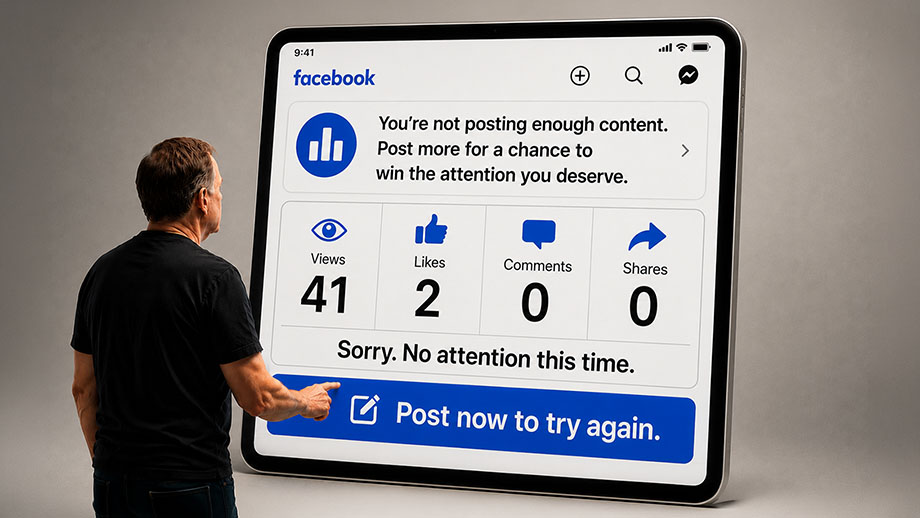
Facebook recently started sending me regular “report cards” about my posting performance.
“You’ve recently been posting less often,” it said. “Create new content to catch up.”
Catch up to what?
I don’t work for Facebook. Nobody is paying me to keep its users entertained. I have no obligation to feed its endless appetite for photos, videos, jokes, observations or essays. Yet the notification implied that posting regularly was somehow my responsibility — and it gently encouraged me to get back to work.
The message irritated me.
At first, I thought I knew why. Like most people, I don’t enjoy software telling me how to behave. The platform wants more content because more content keeps people scrolling, which benefits Meta. That much is obvious.
But after thinking about it for a while, I realized that wasn’t the real reason the notification bothered me.
The real reason was that it touched a nerve I didn’t want to acknowledge. I’ve become an unpaid sharecropper on the social media plantation — and I’ve let myself be brainwashed to crave the attention that the platforms promise me.
For years, I’ve told myself that I use Facebook and Instagram because they help me promote my work. That’s certainly part of the story. When I write an essay that matters to me or take a photo I’m proud of, I’d like the people who might appreciate it to see it. Social media seems like the easiest way to reach them.
But if I’m being completely honest with myself, that explanation has become less convincing over time.
The strange thing is that I no longer post primarily to promote my essays. Most of what I post isn’t links to my work at all.
It’s a picture of one of my cats.
A cartoon.
A joke.
A sunset.
Some passing thought that amused me.
Short political observations.
There are days when I find myself thinking I ought to post something even though I have nothing important to say.
That should have been my first clue.
About 15 years ago, I had one extraordinary day that I still remember vividly. My website was brand new. I was getting a few hundred visitors a day. Then I suddenly received more than 30,000 visitors in one day.
It was exhilarating. I’ve never forgotten how that felt.
For a while afterward, I chased that feeling. I wrote about subjects that I knew would attract readers. I understood my audience, and I understood what they wanted from me. There was nothing dishonest about what I wrote, but I gradually realized I was choosing topics largely because I knew they would bring readers — and bring attention to me.
Eventually, that stopped feeling worthwhile.
I abandoned that approach years ago. Today, I write whatever I genuinely believe is worth saying, whether it attracts readers or not. Some essays perform reasonably well. Others disappear almost without notice. I no longer allow popularity to determine what I write.
Or at least I thought I didn’t.
The Facebook notification made me question that assumption. If I had truly escaped the ego-driven need for applause, why did I still feel this persistent urge to keep posting?
Not writing.
Posting.
Those aren’t the same things.
That’s when I began thinking about B.F. Skinner.
Skinner’s experiments became famous because they demonstrated something surprisingly powerful about behavior. Animals didn’t become the most persistent in their behavior when every press of a lever produced food. They became the most persistent when the reward appeared only occasionally and unpredictably.
If the next press might produce food — but might not — they kept pressing.
That simple observation eventually found its way into casinos. A slot machine doesn’t promise that the next pull will produce a jackpot. There’s no direct cause-and-effect relationship. It merely keeps alive the possibility that it might.
The uncertainty is the product. It produces the adrenaline. It keeps people pulling that lever.
As soon as I thought about that, I recognized something uncomfortable in myself. I post a photo of one of my cats and two people react to it. The next photo receives fifty reactions, even though the two photos are equally good.
A carefully written essay that required hours of thought often vanishes without anyone noticing, while a picture I almost didn’t bother sharing unexpectedly attracts a great deal of attention.
There is no pattern that I can identify.
No formula I can repeat.
No reliable lesson to learn.
And that’s exactly what keeps me posting.
Maybe the next one will be the one people notice.
Maybe the next essay will find its audience.
Maybe the next photo will somehow escape whatever invisible decisions the algorithm is making today.
The next press of the lever might produce a reward.
I hate how familiar that sounds.
The most unsettling part is that social media didn’t create my desire for an audience. Long before Facebook existed, I wanted to write, speak, perform and communicate ideas. Someone I used to know called it “the applause factor” in my life — and she wasn’t wrong. I’ve always wanted people to hear what I have to say.
Social media simply found a way to measure what happens when I speak. Every post arrives with a scoreboard attached to it.
Every photo or video.
Every joke.
Every essay.
The numbers don’t tell me whether the work was thoughtful or true or beautiful. They don’t tell me whether one reader desperately needed to hear what I wrote. They simply report how much visible engagement the platform generated, then quietly invite me to try again.
That’s what Facebook’s notifications are really doing. They aren’t merely asking me to post more. They’re reminding me that another reward might be waiting.
One more photo.
One more joke.
One more observation.
One more essay.
The next one could be different.
I don’t believe Mark Zuckerberg personally set out to turn millions of people into laboratory rats. That’s almost beside the point. Systems built to maximize engagement inevitably discover what psychologists learned decades ago. Intermittent rewards change behavior because they keep hope alive.
That’s what finally bothered me about Facebook’s message. It wasn’t trying to create a habit. It was speaking to a habit that already existed.
I have become fully trained — just like Skinner’s lab rats.
As I was driving home Friday evening, I kept asking myself why I would have allowed myself to slowly start valuing the attention of random strangers, friends and acquaintances so much that I’ve unconsciously been performing like a trained seal to get it.
And then something hit me that I should have realized before.
Without realizing it, I’ve allowed myself to search for significance in the wrong place, not because I didn’t know better, but because a gamified system offered me a shortcut to the dopamine hits that we get from attention.
Meaningful significance comes from our love relationships with people around us. Engaging with those people and those relationships requires more work. It asks for something more than posting a joke or a photo or a political thought. But the payoff goes far deeper.
People feel significance from loving a spouse or a child or a friend or a neighbor. People feel significance from doing the hard work of making a spiritual connection with the divine.
You don’t get significance from gaining a million followers on a social media platform. You don’t get significance from thousands of people laughing at your joke or loving the photo you posted.
All you get from those is the momentary fiction that maybe people like you. It doesn’t mean that, but it can feel that way. And even that is very fleeting.
I’ve quietly and unconsciously been looking to a shortcut to a feeling of significance that I haven’t earned — just as surely as people who engage in gambling are looking for a shortcut to getting unearned money.
I don’t know what I’ll ultimately do with that realization. I’ve left social media before, only to return months later convinced that I needed it to reach readers. Perhaps I do. Perhaps I don’t. I’m honestly no longer certain.
What I am certain of is that I now distrust one of my own motives in a way I never did before.
When I reach for my phone to post something, I no longer know exactly why I’m doing it. Am I sharing something because I genuinely think it’s worth sharing? Or is it because, somewhere beneath my conscious intentions, I’m hoping that this time, the machine will finally pay out?
I never expected to recognize myself in B.F. Skinner’s lab rats.
Once I did, I couldn’t unsee it. And it’s not a flattering realization.
 Eyes convey wordless messages when others seem to disappear
 Wishful thinking: Why Ron Paul can’t (and won’t) be elected president
 You’re not watching real news; you’re watching a scripted show