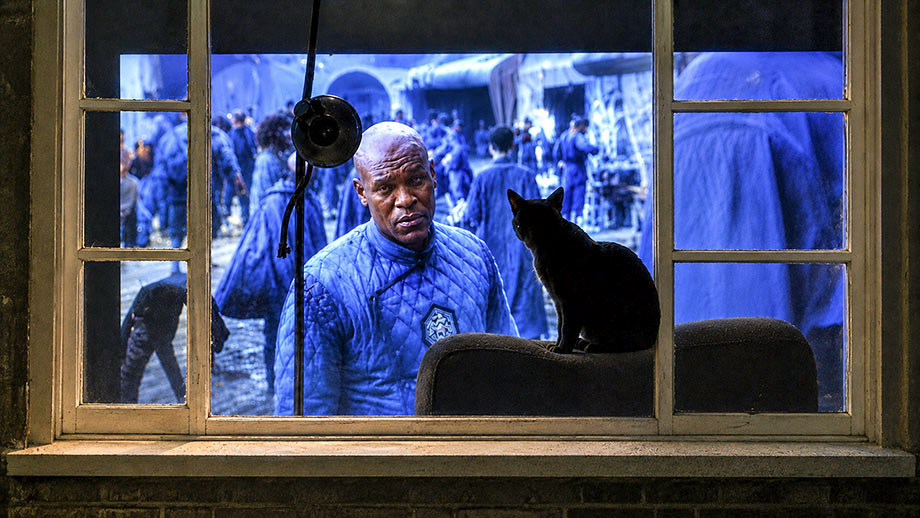
Ray Bradbury wrote a short story in 1951 that has haunted me since I first read it as a teen-ager. And as I walked the streets of my neighborhood late Thursday night, I saw the perfect illustration of what Bradbury warned us about.
I snapped this photo with my iPhone as I passed a house close to home. These people have a television set that’s almost as big as the massive front window of their house.
As I stood there in the dark street, I watched a house where the television set was larger than life. The people inside were apparently engrossed in a movie. Their cat and I were still in the real world, but their real world seemed to have been consumed by a giant television.
“The Pedestrian” is a simple tale about a man who walks in his own neighborhood every night. It’s about a man who hasn’t changed himself to become what his culture has demanded that “normal” people become.
Tonight, I felt like the man from the story.
But the people inside this house are the normal ones who conform to what our culture offers. I’m the iconoclast who sees hidden danger in what my culture offers me in a shiny package.
As the man in the story walks the dark streets — alone because normal people are all inside — all of the houses seem to have the blue glow of television sets shining out of the windows. The story goes on to deal with the man’s encounter with police, who are suspicious about a man who’s outside walking for no reason. But the image that’s always stayed with me is the bluish glow coming from the homes.
Bradbury wrote this when color television wasn’t a thing, when television sets were small and when many people still had better things to do with their time.
But as a late-night pedestrian for many years, I’ve found myself realizing over and over that Bradbury understood what our media was doing to us. He saw how much worse things could still get.
He saw in 1951 the world that we’ve created in 2026 — and he saw more clearly than we do what we were beginning to lose.
When Bradbury wrote, television was the device he saw as consuming the world. He was right, but he never imagined that we’d also carry portable devices that do the same things as our giant television screens. He never imagined that we’d invent media even more dangerous than television.
When I was at dinner Thursday night, a young friend came to sit down with me for a few minutes. She was ostensibly there to talk with me, but her real attention was on the portable computer that we inexplicably still call a phone.
As she sat there, her attention was on the device. She tapped out messages and responses to other people. She scanned a dozen different platforms of various kinds.
She had a conversation — of sorts — with me, but her real focus was on the device. Whatever existed inside that screen was more immediate to her than the flesh-and-blood human being she’d come to visit for a few minutes.
Nobody consciously decided to recreate our society in this way. Nobody decided that we’d build our homes around television sets for decades. And nobody decided that our mobile phones would become portals into an imaginary digital space.
But that’s what happened.
The flip side is the more important part, though.
In accepting the tradeoff our devices have offered us, we’ve slowly chosen to inhabit our media space far more than we inhabit what we used to call the real world.
For most people, that digital world is exciting and real. More and more, the physical space our bodies still inhabit has become little more than the place where our bodies happen to be while our attention is somewhere else.
There’s nothing inherently bad about large televisions. They’re just home theaters that have become increasingly common.
There’s nothing inherently wrong with the digital devices we carry in our pockets, either. They’re just gateways to a world of information and resources of all kinds.
But we’re like children who’ve discovered candy for the first time. We decide that we really like candy. Then we decide that we want to eat candy pretty much all the time.
We’re making unwise choices about the tradeoffs we’re offered — and the worst part is that we’ve gone so far down that road that we no longer recognize them as tradeoffs.
We no longer understand that, in accepting the bargain our culture has offered us, we’re giving up something we no longer even remember. We’re increasingly giving up a real connection to the real world. We’re increasingly giving up a real connection to the flesh-and-blood people around us.
Bradbury thought television was the danger because television was the newest technology of his time.
It turns out television was only the beginning.
And most people still haven’t understood that we’re giving up something we’ll never get back — now that we’ve given ourselves almost completely to the digital gods we’ve made.
 I fear nobody will come with me as I start down a difficult path
 If no mortal can ever be perfect, should we even try to be good?
 How one woman’s grand gesture for love turned into a nightmare