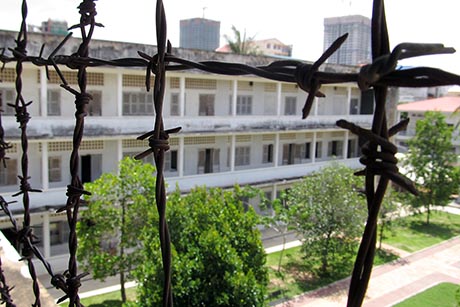
In 1975, Chao Ponhea Yat High School in Phnom Penh, Cambodia, was converted into a prison. The communist Khmer Rouge had just overthrown the previous government, and the regime led by the murderous Pol Pot spent the next four years torturing and murdering people in this place. Although nobody knows for sure, it’s thought that somewhere between 17,000 and 20,000 men, women and children were brought here. Only seven of those are known to have lived.
We have roughly 35 years between today and the horrors of what happened at the place known at the time as Security Prison 21 (S-21). The complex is now known as the Tuol Sleng Genocide Museum. That’s one of the buildings of S-21 above just a few weeks ago, seen through the barbed wired that helped keep desperate people from getting out. What lessons can we draw from S-21?
The comfortable lesson is that there was something uniquely evil about communism or the Khmer Rouge regime that took over there. Maybe it’s something unique to Cambodians or to Asians in general. But those sorts of explanations don’t hold up. You can find similar torture and murder in many places around the globe. We certainly saw vicious inhumanity in Nazi Germany, not just from highly trained SS killers, but from ordinary people. When almost 2,300 Jews were killed in 1941, one of the killers was a police secretary back home in Vienna. Walter Mattner described the killings to his wife in a letter:
 When you can’t call one you love, silent phone just taunts your need
 Ayn Rand’s legacy: Should we consider her a ‘great libertarian’?
 Will you help me understand where all my readers are from?
 Beauty is everywhere around us, when our eyes are open to see it
 We’re all masters of denial when facing painful truths in our lives
 ‘Post-racial’ America? We’re nowhere close to that — and may never be
 I was a terrible preacher, because cookie-cutter truth seemed empty
 ‘Metaverse’ future seems easy, but humans thrive on challenge
 Will a mechanical body allow you to live forever in a few decades?