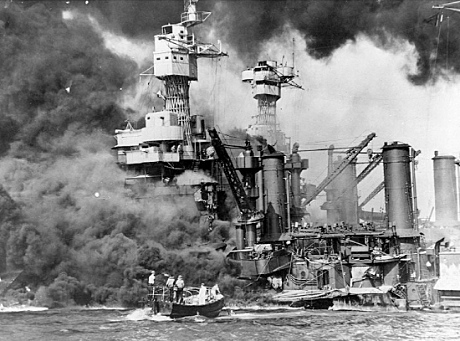
When I was growing up, I learned the standard Pearl Harbor attack story. The peaceful United States was minding its own business and staying out of the war raging in Europe when Japan suddenly attacked Pearl Harbor without any provocation. The Japanese were motivated simply by imperialist plans for conquest, we were assured.
I loved military history back then, and the war in the Pacific during World War II was my favorite. (If you ever want me to bore you with a detailed account of the Battle of Midway, I’ll be happy to do so, because it’s my favorite battle.) I have tremendous admiration for the people who fought that war and who sacrificed greatly in order to win it. Unfortunately, I can’t say the same thing about the political leaders whose actions led to the war.
When I was 12, I learned Franklin Roosevelt’s rousing speech on Dec. 8, 1941, asking Congress to declare war on Japan. (I can still do large parts of it, and I’m sure it’s funny to hear me emulate FDR’s accent.) I believed that Roosevelt was a great wartime leader.
 Ron Paul asks 31 tough questions that our politicians won’t answer
 Without God, my unloving heart can’t truly love unlovable people
 I was agonizingly slow to ‘get it,’ but the joy of music changed me
 We will destroy ourselves if we don’t learn to love our enemies
 Who is God? What is real truth? All I know is my own experience
 I wanted to be Capt. James Kirk; have I become Ignatius J. Reilly?
 My life will matter only if I can show love and meaning to others
 Unexpected proposal leaves me pondering my craving to be loved
 Just underneath a civilized veneer, savage conqueror lives in my DNA