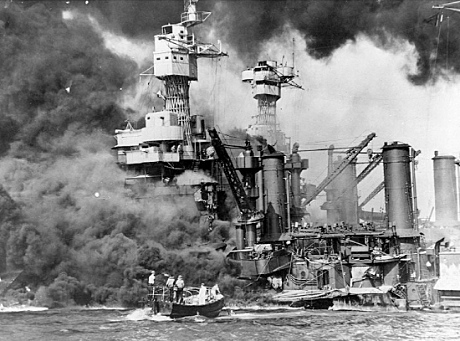
When I was growing up, I learned the standard Pearl Harbor attack story. The peaceful United States was minding its own business and staying out of the war raging in Europe when Japan suddenly attacked Pearl Harbor without any provocation. The Japanese were motivated simply by imperialist plans for conquest, we were assured.
I loved military history back then, and the war in the Pacific during World War II was my favorite. (If you ever want me to bore you with a detailed account of the Battle of Midway, I’ll be happy to do so, because it’s my favorite battle.) I have tremendous admiration for the people who fought that war and who sacrificed greatly in order to win it. Unfortunately, I can’t say the same thing about the political leaders whose actions led to the war.
When I was 12, I learned Franklin Roosevelt’s rousing speech on Dec. 8, 1941, asking Congress to declare war on Japan. (I can still do large parts of it, and I’m sure it’s funny to hear me emulate FDR’s accent.) I believed that Roosevelt was a great wartime leader.
 Dirty little secret: Politicians have incentive to whip up your fears
 Arming teachers for safety likely to create gang that can’t shoot straight
 FRIDAY FUNNIES
 NYC schools ban ‘birthday,’ ‘crime,’ ‘dinosaur’ and ‘divorce’ from tests
 Who was this attractive woman? Why did her story not ring true?
 Time and maturity should change what we believe we need in mates
 I thought I saw her face — and I whispered, ‘Are you proud of me?’
 Despite liberal predictions, ending gun bans didn’t lead to Wild West
 If you aren’t free to to be a bigot if you choose, you’re not really free