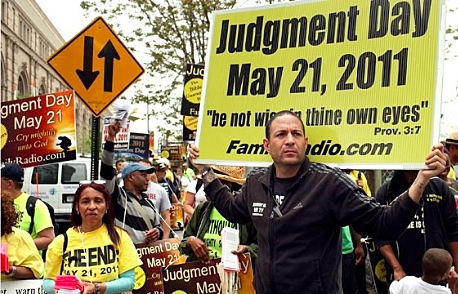
It was a year ago today that the world was supposed to end, according to California radio preacher Harold Camping. Of course, when it didn’t happen, he suddenly found new evidence in scripture to support his revised calculations and said the end would come five months later. That date also passed without the world ending.
It’s easy to make fun of a nut such as Camping — and I did my share last year — but there’s a lesson here for anyone who’s so certain of the accuracy of his own beliefs and predictions: Any of us can be wrong. Certainty doesn’t make a person right — and dogged determination to stick to a prediction or position might just mean the person is arrogant and stubborn. (Unfortunately, strident confidence in error is rewarded in politics, while thoughtful candor is punished.)
How did Camping and his followers go so wrong? I’ll never know. Anyone who knows the Bible know that there’s nothing there to make a reasonable person believe he can predict the end of the world. Anyone who tries is simply bringing his own assumptions (and his own arrogance) to bear in order to come up with a date that isn’t there. (If you want to get a heated argument going, ask people from certain Christian groups to get together and compare notes about what’s going to happen when the world ends. Then hide the breakables and get out of the way.)
On the rare occasions when I could get away with disagreeing with my father when I was a kid, he would tend to say, “Well, you just think you’re right.” That statement always puzzled me. Obviously I thought I was right or I wouldn’t hold whatever position I held. Isn’t that true for all of us?
 FRIDAY FUNNIES (for Christmas)
 Major parties compete to see who can tell the biggest lie about jobs
 Miss. church turns back clock by refusing to marry black couple
 Alternative cultures exist because mainstream culture is alienating
 Hearing what your gut whispers might save you from wrong path
 Federal checks are destroying incentive to take entry-level jobs
 Town’s new fine for public profanity points to problem of ‘public’ spaces
 What if Jesus was serious about all those things He told His followers?
 If you’re still able to read this site, Harold Camping is wrong yet again