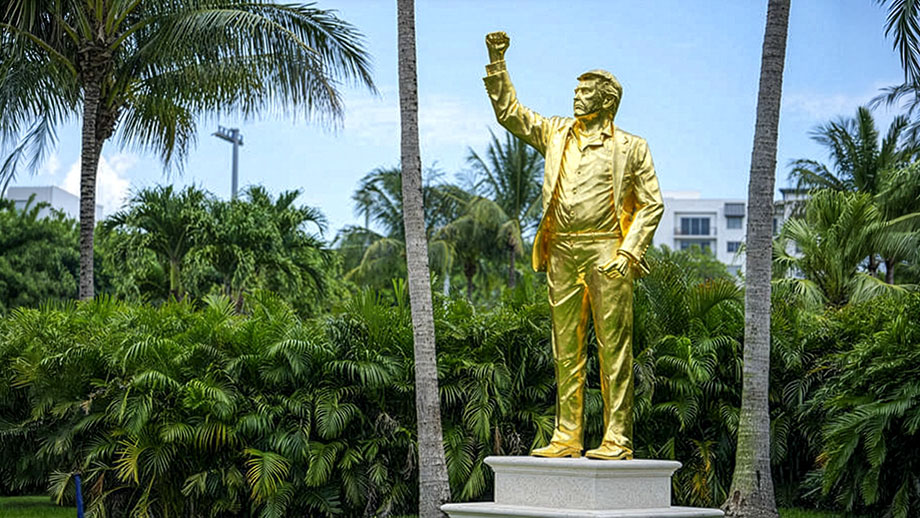
If a 22-foot-high golden statue of a narcissistic ruler doesn’t remind you of the golden calf, you probably aren’t very familiar with a certain story about the children of Israel in the Sinai desert.
And the people who endorsed this colossal monument to ego seem to think that if they keep saying, “It’s not a golden calf,” people will believe them. Sadly, many naive victims will do anything to avoid accepting that they’ve been snookered by a narcissistic con man.
I rarely talk about Donald Trump in a serious way anymore, but the recent unveiling of a golden statue of Trump — dedicated by Christian and Jewish clergy — was so outrageous that I had to try one more time. It’s painful to realize that many of my fellow Christians still haven’t accepted that their support of Trump is very much like the Israelites’ worship of a golden calf 3,500 years ago.
So I made a two-minute video late last night about this Trumpian “golden calf.” It’s embedded below.
In the video, I accidentally said the story of the golden calf was from about 1,500 years ago, but I was off by about 2,000 years. The story is actually said to have taken place about 3,500 years ago.
Fellow Christians, stop making excuses for this lying narcissist. This isn’t about ideology or politics. It’s about decency and core moral values.
 ‘This path leads to somewhere I think I can finally say, I’m home’
 Children’s joy and innocence pierce my heart, bring me hope
 Arrogance and stupidity go hand in hand for the coercive state
 How can we be lonely while we’re surrounded by billions of people?
 Without hope for a better future, depression grabs us by the throat
 Hank Williams story reminds me I’ve always wanted to be a star
 For the record, what you read here is from me, not from robots
 Confirmation bias means most of us assume our opponents are ‘morans’
 How do we often know things which we shouldn’t really know?