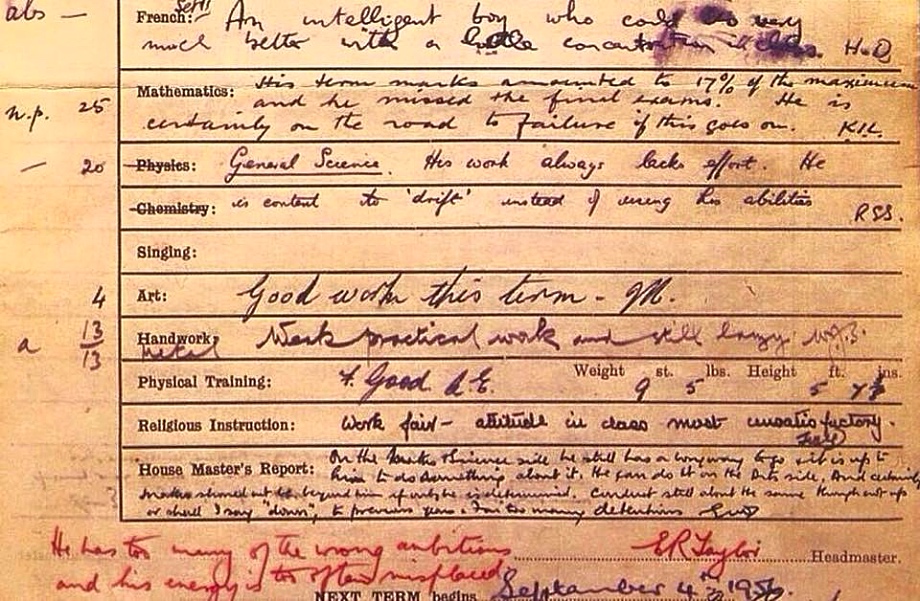
 When John Lennon was 15 years old, the smart people in authority at his school didn’t see him as a world-changing artist.
The headmaster wrote this on Lennon’s report card that year: “He has too many of the wrong ambitions and his energy is too often misplaced.” (Click the graphic above to see a larger version.)
Although he was seen as intelligent, a science teacher wrote, “His work always lacks effort. He is content to ‘drift’ instead of using his abilities.”
In math, he missed the final exam and the teacher wrote, “He is certainly on the road to failure if this goes on.”
His teachers clearly didn’t think much of him. By the accepted standards of the world, he was heading toward failure. Surely he would become a nobody — because he refused to fit into the box that the world was trying to push him into.
Because of his work with the Beatles, though, Lennon turned out to be a pivotal cultural figure of the 1960s. He will be remembered long after everyone has forgotten those experts who judged him.
 What can a free society do before an unstable person commits a crime?
 Quit thinking about ‘jobs’; Think about what value you can provide
 Our reactions to others’ suicides say something about how we view life
 Federal checks are destroying incentive to take entry-level jobs
 Making the ‘right’ enemies shouldn’t make a politician electable
 Time to face facts: Most people don’t really want individual liberty
 Apple podcast listing means you can now subscribe to Love & Hope
 Money isn’t evil, but obsession with it brings out worst in us
 Moral priorities: ‘If we free the slaves, who will pick the cotton?’


