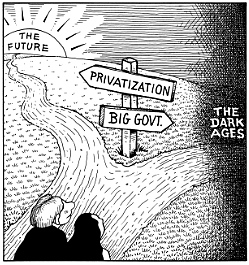
 If there’s one thing that most conservatives and libertarians agree on, it’s about the gospel of privatization. Both groups agree that everyone is better off when governments contract with private companies to perform services.
If you look at the Reason Foundation’s website, you can find all about the glories of privatization and why it’s better than having government employees perform the work.
You’ll see praise of privatizing public works, garbage collection, lotteries and airport screening, among others. I’m sure the facts of the reports and studies are accurate as far as they go, but they’re missing the most basic point, as far as I’m concerned.
If I am forced by a city or state to fork over the money to pay for paving roads or collecting trash or maintaining public parks, how much does it matter to me whether the employees who do the work are government employees or on the payroll of a company that I’m required to support, whether I like the work or not?
I’ve been thinking about this because I’ve been noticing horribly incompetent companies I deal with lately. That’s made me wonder why I should prefer dealing with one of them — if I didn’t have any choice in the matter — rather than government employees. Why is an incompetent private company with a monopoly any better than an incompetent government?
 Star Trek film is reminder that adults no longer run Hollywood
 Don’t personalize: The system is the issue, not Obama or any individual
 I’m a liar — and you are, too; most of all, we lie to ourselves
 THE McELROY ZOO: Meet Lucy, the dog who used to live on a chain
 If you’re offered a second chance at creating a happy family, grab it

 Will rising anger about personal economic pain lead to trouble soon?
 With each ‘improvement,’ we’re losing family and community