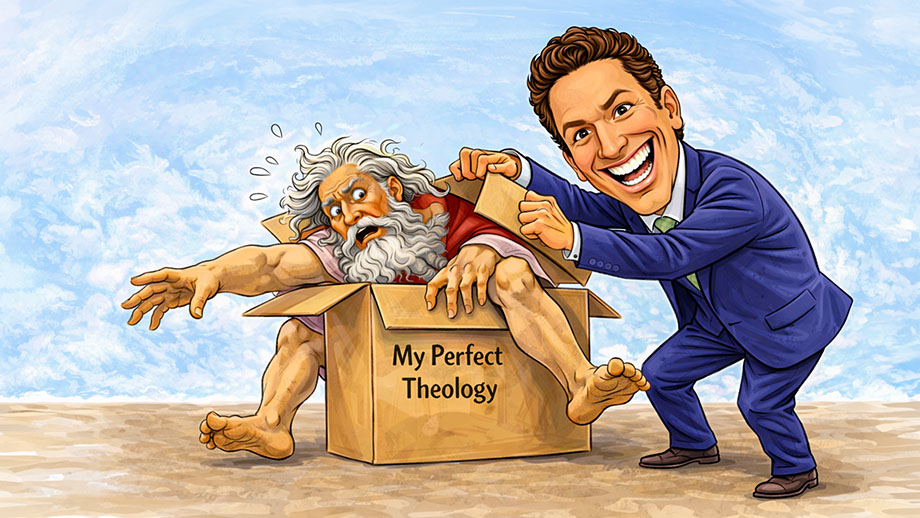
I used to be certain.
Not just confident or comfortable, but certain in the way only a young person can be when handed a complete system and told it explains everything. I had been taught a theology that divided the world neatly into what was true and what was false. It came with answers for every question that mattered and, more importantly, it came with the assumption that those answers were final.
I didn’t question it. Why would I? It was what I had been given. It felt like truth because it felt like home.
When I listen to people argue about theology now, I often recognize something uncomfortably familiar. I hear the same tone of certainty I once had. I see people defending systems they didn’t build but have fully embraced. They assume their conclusions are objectively true and everything else is objectively wrong.
I understand that mindset because I once lived there.
What changed wasn’t some moment of doubt. I didn’t doubt God. It was a long, slow realization that the system I trusted wasn’t as complete as I had believed. The more I studied the history of theology instead of just repeating what I had been taught, the more I saw how much of what I believed had been shaped by culture, tradition and human interpretation.
That realization didn’t destroy my Christian faith. It did something far more unsettling. It forced me to take responsibility for it.
It’s seductive to believe we can know all truth if we just adopt the right system. That idea runs deeper than theology. It shows up in philosophy, politics and even science. There’s a quiet assumption behind many belief systems that says if you accept the right framework, you can deduce everything else with certainty.
I once believed that. Now I don’t.
What I’ve found instead is that the truth we can be certain about is surprisingly narrow. It’s grounded in experience. It’s shaped by intuition. And even then, it’s incomplete. If we’re honest, we have to admit we’re going to be wrong about a lot of what we believe. We’re also going to have to live with uncertainty.
That’s not a comfortable place to be. Certainty is easier. Certainty feels safer. But certainty often comes at the cost of honesty.
The only way I’ve found to remain intellectually honest and spiritually open is to become comfortable saying, “I don’t know,” about a lot of things.
That phrase would have felt like failure to my younger self. Now it feels like humility.
I’m more certain today of the reality of God than I’ve ever been. But my certainty isn’t rooted in a system anymore. It’s rooted in experience. I know God in the way you know something that can’t be fully explained. It’s real, but it’s not easily reduced to words or formulas.
And that’s where the tension begins.
Because we all want to explain what we’ve experienced. We want to define it, categorize it and, eventually, control it. We build theological systems that try to capture something that is, by its nature, larger than our ability to contain it.
We take something infinite and try to fit it into something finite.
We build boxes. And then we label them with confidence.
Most people don’t arrive at their religious identity through careful theological reasoning. They inherit it. They absorb it from their culture. It becomes part of what feels normal long before it becomes something they examine.
That’s why theological debates often feel less like a search for truth and more like arguments over the rules of a game. Whatever version of the rules you grew up with feels correct. Everything else feels wrong.
We rarely notice how much of what we believe is shaped by familiarity.
I see this most clearly in myself. When I hear someone express a belief that contradicts my own, my first instinct isn’t curiosity. It’s judgment. I think, “How could anyone believe that?”
And then the obvious answer hits me.
They believe it for the same reason I believe what I believe. It makes sense to them. It fits their experience. It feels like truth. Or else it was just what they were taught.
To them, my beliefs are just as questionable.
That realization doesn’t mean all ideas are equally valid. But it does mean that humility is necessary if we’re serious about truth. It also means we should be cautious about confusing confidence with accuracy.
In many churches today, I see another layer to this problem. We’ve learned how to create powerful emotional experiences. We build environments that foster connection, inspiration and a sense of belonging. There’s real value in that. Community matters. Shared experience matters.
But I sometimes wonder whether we’re mistaking those experiences for something deeper. It’s possible to feel something powerful without actually encountering God. It’s possible to substitute a carefully crafted emotional experience for the thing our souls are actually searching for.
I don’t say that as a conclusion. I say it as a question I can’t shake.
Because the more I’ve let go of certainty, the more I’ve become aware of how much I don’t understand.
And strangely, that awareness has made my faith stronger, not weaker.
I’m no longer trying to defend a system that explains everything. I’m trying to remain open to a reality about a God who I can’t fully grasp.
I’m more interested now in experiencing God than in explaining him. More interested in recognizing truth than in proving it. More willing to admit that whatever I understand is only a small part of something much larger.
If my beliefs today were identical to what they were when I was 25, that would probably say more about my unwillingness to question them than about their accuracy.
Growth requires change. And change requires the willingness to be wrong.
I don’t have everything figured out anymore. I’m not pretending to know everything.
But I’m more convinced than ever that God is real.
And I’m more aware than ever that he is far bigger than anything I can fit into a theological box.
 Try a new game: Make others smile — and let yourself smile with them
 The drama of a world gone mad leaves me longing for real peace
 Love & Hope — Episode 4: