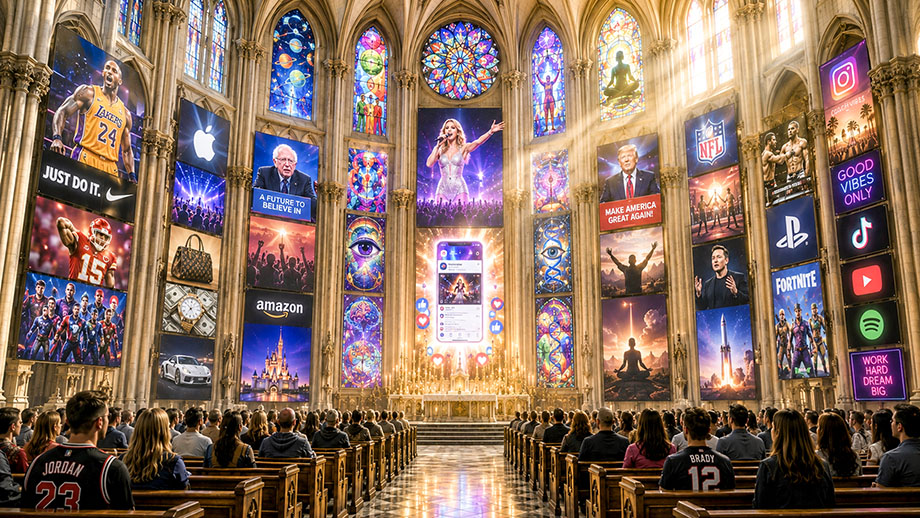
Lauren is a university professor. We met several years ago and she immediately impressed me. She was intelligent, thoughtful and highly accomplished. She came across as serious and rational.
One day, she started talking to me about Taylor Swift.
I assumed she simply liked the music. Millions of people do. There wouldn’t have been anything unusual about that. But the longer she talked, the stranger the conversation began to feel.
She told me about traveling to concerts. She talked about exchanging “friendship bracelets” with strangers she’d never met before. She described the emotional connection fans felt with each other — and with Swift herself — in ways that sounded as though she was talking about a guru or messiah.
These weren’t simply people attending concerts for entertainment. They were devotees gathering with other devotees who believed they were participating in something meaningful together. They seemed to believe they had discovered some important truth.
What fascinated me most was the intensity of it. I’ve known religious converts who spoke with less passion. And this woman wasn’t unusual.
Over the last few years, I’ve watched young women with ordinary jobs spend astonishing amounts of money flying across the country to attend multiple performances of the same Taylor Swift tour. Some can barely afford to pay their monthly living expenses — as they live paycheck to paycheck — yet they save for months to pay thousands of dollars for concert tickets and travel. All because the experience somehow feels important enough to justify the sacrifice.
It’s not that the experience is fun. It’s that it feels important to them. That distinction matters.
Because the more I watch modern culture, the more difficult it becomes for me to believe that human beings ever truly stop worshipping.
This isn’t limited to Taylor Swift fandom or celebrity culture.
We see it everywhere now. People throw themselves into causes, movements, fandoms and identities with an intensity that increasingly resembles religion.
(If you don’t think college football is a religion, try to schedule a wedding on the Third Saturday in October in either Alabama or Tennessee.)
Human beings never really stop creating gods for themselves. We simply change the names and symbols attached to them.
A century ago, many intellectuals confidently predicted that religion would slowly disappear as science and technology advanced. Human beings would become more rational, less superstitious and more enlightened. We would no longer need old ideas about transcendence, sacredness or spiritual meaning because modern knowledge would replace them.
But that hasn’t happened at all.
Instead, many of the same impulses that once attached themselves to religion simply migrated into other parts of modern life.
We still hunger for belonging. We still long for meaning and purpose. We still crave emotional experiences that pull us beyond ordinary existence and make us feel connected to something larger than ourselves.
And if those desires aren’t being directed toward religion, they almost always seem to attach themselves to something else.
Sometimes it’s politics.
Large numbers of people now organize their entire identities around political movements with a level of emotional intensity that often resembles religious devotion more than simple disagreement over public policy. Political leaders become messianic figures. Opponents become moral monsters. Heretics inside the movement are treated with even greater hatred than outsiders.
Some people now speak about political causes with the sort of certainty and moral absolutism that previous generations associated with religious crusades.
Other people turn consumerism into a kind of religion.
They spend their lives chasing status, possessions and experiences that promise fulfillment but never quite deliver it. The modern economy increasingly runs on the promise that happiness is always one purchase away. We may no longer gather in cathedrals, but we still gather in temples devoted to consumption and self-image.
Others seek transcendence through internet tribes, conspiracy theory movements, wellness culture or ideological communities that give them identity and belonging in a fragmented world.
Even technology itself increasingly takes on religious overtones.
People speak about artificial intelligence and scientific advancement with language that sounds remarkably similar to older religious promises. Technology will save us. Science will solve everything. Human limitations will eventually disappear. Death itself may someday be conquered.
Science is an extraordinary tool for understanding the physical world, but it was never designed to answer the deepest human questions. It can explain how matter behaves, but it cannot explain why beauty moves us or why love matters or why grief feels sacred.
It cannot tell us what kind of people we should become.
That’s part of the reason our substitute religions keep failing us.
We keep asking temporary human systems — which function as false gods — to satisfy permanent spiritual longings.
Politics can’t save our souls. Celebrities can’t give our lives ultimate meaning. Consumption can’t cure loneliness. Technology can’t remove the ache human beings feel for permanence and transcendence.
Finite things make terrible gods.
That doesn’t necessarily mean every person must embrace organized religion. But modern society often misunderstands human nature.
We like to imagine ourselves as purely rational creatures motivated mainly by logic, economics and self-interest. Yet human beings consistently behave as though we were built for reverence, ritual, belonging and worship.
We seem to need meaning the way our bodies need food.
And when traditional religion weakens, those instincts don’t disappear. They simply scatter themselves across politics, celebrity culture, ideology, technology and countless other substitutes that struggle beneath the weight of expectations they were never meant to carry.
Perhaps that’s why so many people today seem spiritually restless even while surrounded by entertainment, comfort and distraction.
We’re slowly losing our religion, but we still keep finding new gods.
 Time and attention are flawless guides to what a person values