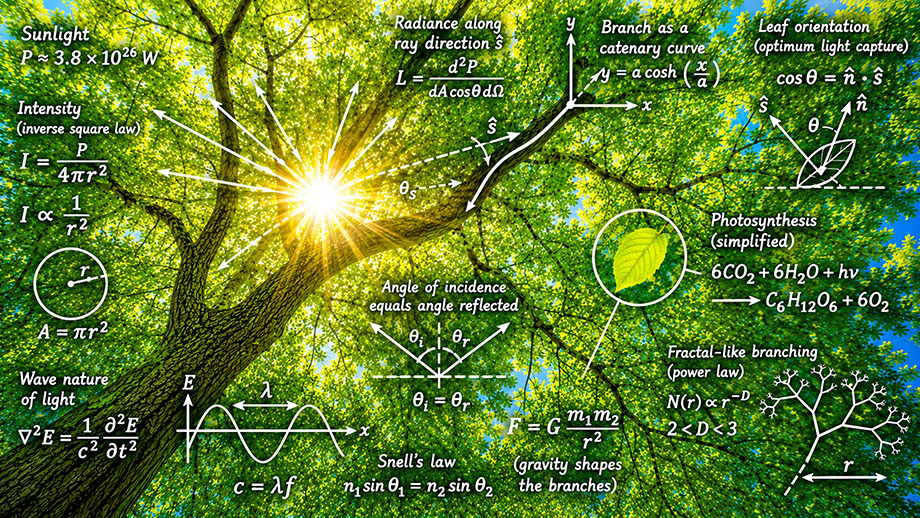
The truths that matter most in life cannot be proven.
I know that love is real, but I can’t prove it. I am absolutely certain that some things in this world are indescribably beautiful. Painfully beautiful. I know those things matter in ways that I can’t explain or understand. I’m certain that there is a reality beyond the physical world I can see and touch. I know there’s a creator — who I experience as God — who is just as real as anything I can touch or see or hear.
I can’t prove any of these things, but I know they’re true.
For me, they’re not theories or hopes or abstract concepts. They’re facts about reality. All of these things are part of my knowledge — but it’s “irrational knowledge.”
Maybe “non-rational knowledge” would be more precise, but I adopted this phrase from a distinction that Russian novelist Leo Tolstoy made between rational and irrational knowledge. Rational knowledge is what we get from science and other sorts of experimentation with the physical world. Irrational knowledge is what we feel as though we just know — through intuition, gut feeling, faith, whatever you want to call it.
My version of irrational knowledge might be different from yours. And that’s OK. But when we look at human groups around the world and over long periods of time, we find that some shared intuitions about irrational knowledge are pretty widespread.
Rational knowledge helps us to survive and to live in prosperity. Irrational knowledge feeds our hearts and gives us purpose and meaning.
The longer I live, the more I value meaning and the less I value prosperity.
Unfortunately, we’ve become a culture that claims nothing matters except material reality. The assumption that’s embedded in our culture is that intuition and irrational knowledge are worse than unproven.
The unspoken assertion is that such things must be wrong because they can’t be proven. And there’s a condescending attitude that anyone who believes in such irrational knowledge — or who speaks of the meaning of life — is deluded at best and stupid at worst.
Since the Enlightenment, even religious people have bought into the notion that a thing can’t be truth unless it can be proven. That’s why the world is now filled with “apologists” for religions who are eager to prove their beliefs and their sacred texts are objectively and rationally true.
This is a fool’s errand for those apologists. But it’s also a fool’s errand for atheists to assert that God can’t exist.
It baffles me that so many theists believe they can prove God — and that so many atheists believe they can prove there is no God. Proving such a thing isn’t reasonable or possible. Every proof — for both sides of the argument — comes down to which assumptions you choose to accept.
What you believe will be determined by either your blind faith or by your experience.
When I was young, I believed what I was told. Today, I believe only what I’ve experienced — and I think that’s the most reasonable approach, whether you come to the same conclusions I do or not. I’ve experienced something or someone I know as God, so I believe.
I see God in nature and find him in the world around me. I suspect most people will do the same if they’re open to the experience — but I can’t rationally convince someone to believe what I believe, just as nobody can convince me to ignore my experience and fail to believe.
But it requires just as much faith to declare dogmatically that there is no God as it requires to believe in any god. It can be rational for someone to say, “I see no evidence for the existence of God,” but it’s not rational to declare certainty that God can’t exist.
Irrational knowledge deals with things completely beyond the physical world. It’s noteworthy to me that so many of us have felt the same intuitions and experienced the same sensations in our souls. But trying to apply the methods of science to this sort of knowledge is a category error. It’s like trying to prove that a sunset is beautiful by applying a geometric proof.
The rules of the physical world don’t apply to the spiritual world.
The rules of the spiritual world don’t apply to the physical world.
Those who confuse the two — or those who assert that only their world should matter — are cutting themselves off from important knowledge.
I accept the laws of science and physical reality — to the degree we understand them — because this is the most reasonable way to interact with the physical world.
Accepting the things that science has brought us has made our world immeasurably wealthy. It’s made us far more comfortable than our ancestors could have dreamed of.
But suppressing the irrational knowledge that deals with the world beyond the physical world has made our culture spiritually bankrupt. It’s caused many millions of people to assume nothing can be true — nothing can matter — if it can’t be measured or proven.
Our culture is having a spiritual crisis.
We have people who are comfortable and healthy — and who experience constant pleasure and entertainment. But many millions of those people feel empty on the inside.
They’re empty because their culture has told them there is no purpose for life. There’s no meaning in life. The culture has told them they don’t matter except as producers and as consumers.
I’ve learned that irrational knowledge is real. I’ve learned that rational and irrational knowledge aren’t in conflict. Each is important for its own realm.
But the desperate need of a wealthy and comfortable society is to understand that life has meaning and purpose — and understanding that requires irrational knowledge.
 What’s so important to you that you’d like to take it to your grave?
 If they steal from taxpayers long enough, shoplifting seems normal
 Why do I suffer deep alienation when I fear I’m misunderstood?