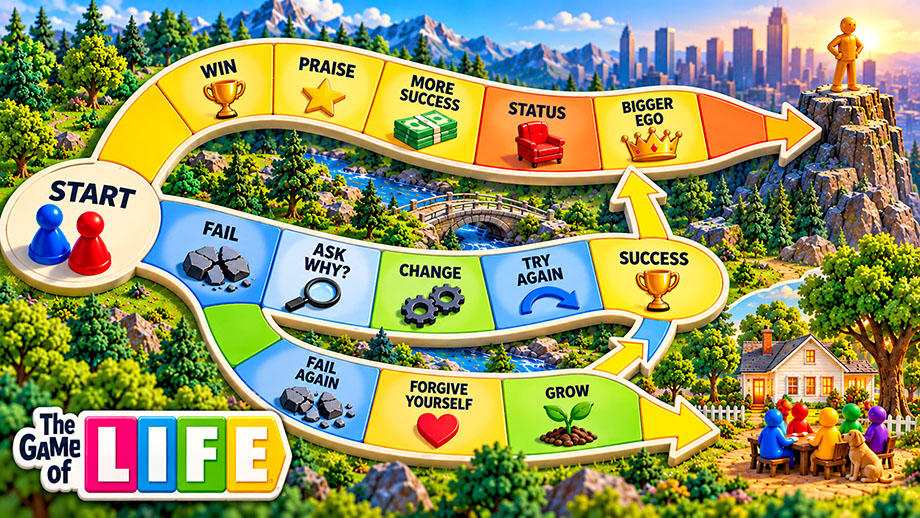
I was meeting Wednesday with a man who’s interested in joining my company as an agent. He had told me about the twists and turns of his own career, and he asked how I had ended up where I am professionally.
I told him about my early successes in journalism. I mentioned owning several small publishing businesses, then becoming a publisher for a newspaper chain — and then spending years as a political consultant. And on and on. I tried to quickly summarize a long story.
“I still haven’t decided what I want to do when I grow up,” I joked.
I didn’t mention the specifics of the many failures in my life. I didn’t talk about the dreams that I’ve given up. And I definitely didn’t talk about the role that luck and chance have played, for both good and bad.
The truth is that I’ve felt lost for much of my life. I started out with a life map that was totally wrong. I trusted cultural training that I didn’t know to question. I set goals that would have made me miserable if I’d achieved them. And the things that now matter most to me would have sounded trivial or inconsequential when I started.
If the 25-year-old David could see where I am now, he would have been dismayed. And if the current version of myself had ended up where my 25-year-old self expected to go, I would be miserable.
My losses and defeats have taught me plenty of important lessons. My wins and successes have felt great to my ego, but they’ve taught me virtually nothing.
Life has been just the opposite of what I expected.
When I was young, I had no tolerance for losing. I couldn’t even imagine what failure might be like. I was very successful with the things I tried. I impressed a lot of people. I created great expectations for myself.
And I was really impressed with myself.
When I started experiencing failures, it was devastating. I took some big swings at things early in life. I made mistakes that contributed to my failures. Other things were beyond my control. But I felt like a failure and I had to figure out what to do with the burden of this failure.
Slowly, I developed a tolerance for failure. And a strange thing happened.
First, my overinflated ego was punctured. That hurt, but I eventually reached a middle ground. I could accept that I had genuinely been the bright and talented guy who I had believed myself to be, but I learned that the things I had been aiming for weren’t worth the investment of my life after all.
Second, I realized that I had to re-examine the map I’d brought with me into life. I had to change my values. I had to give up my grandiose fantasies for myself — the dreams that I thought would make me happy.
Third, I learned that accepting responsibility for my failures meant learning lessons that could allow me to rewire myself. My growing tolerance for the discomfort of failure meant that I could grow by making changes in myself — changes that could make it less likely that I’d keep making the same mistakes over and over again.
I do repeat some negative patterns — and those have held me back — but the more I realize that I’m the source of most of my problems, the more I’m willing to see the obvious patterns and make changes.
Another thing that I’ve found to be key to being at peace with myself — enough to grow spiritually and emotionally — is that I’m much more willing to forgive myself for my failures and my foibles than I once was.
I used to beat myself up about anything that might make me look bad to others. I wanted others to see me as successful and competent and brilliant.
In a perfect world, my ego would still like people to think highly of me. I’m human enough to want to be seen as someone who’s amazing and worthy and respected.
But the more I move through life, the more I realize that those things don’t matter. It doesn’t matter if people see me as successful. It doesn’t matter whether people envy me. It doesn’t matter if people are impressed by who I appear to be on the outside.
The things that matter to me now weren’t on my map of life when I started out. I’m far more concerned about whether I show love and empathy and compassion to others. I’m far more interested in how I make other people feel than I am in how they feel about me.
My life map has turned upside down. The things that mattered to me then turned out to be paths to nowhere. The things I thought were paths to humiliation and failure turned out to be roads to love and belonging.
I’m thankful for my failures. I’m thankful that I learned to listen to the still small voice that taught me a different way to live.
And I’m thankful for the others who are also traveling on the same path — toward love and community and belonging.
My childish ego still enjoys the memories of past success in my life. My spirit is mature enough to be grateful that I never found the empty success that I once craved.
 After 50 years of being alone and disappointed, boy finally gets girl
 Without hope for a better future, depression grabs us by the throat
 If you want permission to skip that Super Bowl party, here it is