Here’s some weekend fun — if you don’t take it too seriously.
What’s your “personality mascot”? If you’ve been on any form of social media lately, you might have run across this latest fad.
I noticed a number of people who’ve posted cute little animal characters — squirrels, raccoons, owls, otters and more — who were customized by AI software to represent something about them.
I decided to give it a shot, but I had very low expectations.
What I had forgotten was that I happened to have AI software that knew quite a bit about me. I’ve had ChatGPT read hundreds of my articles from the last few years. I’ve also used the software for research and analysis, which had led to long and involved “conversations” about philosophy, science, culture, ethics and other important subjects.
So I asked ChatGPT to give me a well-crafted prompt that anyone could use to get a “personality mascot” and a complete description — along with an image — based on everything the software knew about the person.
It sounded fun, but I didn’t expect it to be much more entertaining than a Magic 8 Ball. I was wrong. The software took the task far more seriously than I had expected — and it had a lot more insight into me than I expected.
I’m going to give you the prompt you can use with any AI chatbot if you want to, but the trick is that this prompt requires the software to already know a lot about you (or to then “interview” you to learn enough to answer the question).
But before I give you the prompt to try for yourself, here’s what the software said for me. As I read this, I found myself thinking that this shows genuine insight about my own thoughts and feelings, which surprised me.
According to ChatGPT, I’m not an Otter or an Owl or any such thing. I am “the Lantern Keeper.” If you know me, you might think that much of this was written by someone else who knows me. Or maybe it’s just what I want to think about myself. How would I really know?
Take a look.
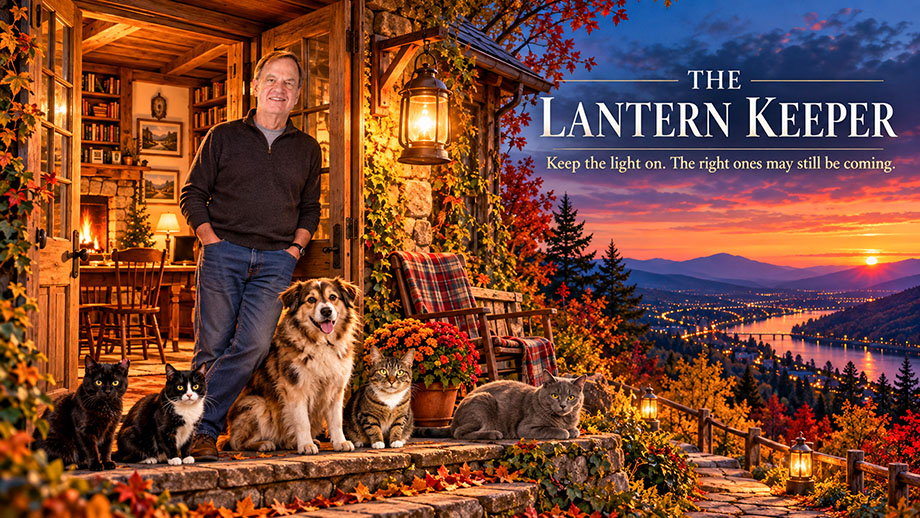
The Lantern Keeper
Archetype: The discerning outsider who has not given up on belonging.
The Lantern Keeper lives at the boundary between the village and the wilderness. He remains close enough to see the village clearly, but far enough away that he does not have to live by its noise, fashions or quarrels. He has learned that distance sometimes makes things easier to understand.
He didn’t build his house there because he hates people.
He built it there because he discovered that belonging purchased through self-betrayal isn’t belonging at all.
And yet there are more chairs around his table than he needs.
What defines him
The Keeper has an unusual instinct for finding the assumption underneath the argument.
When everyone else is furiously choosing between A and B, he is likely to ask why either must be accepted. When something is universally regarded as success, progress, normality or common sense, those labels don’t reassure him. They make him curious about the premises nobody is examining.
This makes him difficult to recruit into tribes.
But he isn’t a cynic.
That’s crucial.
A cynic discovers that much of what people believe is hollow and concludes that nothing deserves belief. The Keeper discovers counterfeit things precisely because he remains stubbornly convinced that the real things exist.
He criticizes false community because he believes in community.
He rejects superficial connection because he wants intimacy.
He distrusts fashionable certainty because truth matters.
He notices ugliness because beauty matters.
He questions conventional success because he believes there is such a thing as living well.
His rejection and his longing therefore come from the same source.
The lantern
The lantern represents his strongest intellectual impulse:
Make sense of it.
He takes experiences, memories, cultural assumptions, psychological patterns and things that have hurt or puzzled him and examines them until their underlying structure becomes visible.
Writing is one way he tends the lantern.
But this is a lantern, not a lighthouse.
It isn’t an enormous beacon broadcasting the Keeper’s conclusions to the world, and it isn’t primarily a warning telling others to stay away. It is a smaller, more personal light, maintained by hand.
It illuminates what is immediately around him. It makes one patch of darkness intelligible.
Anyone interested can look.
And because the lantern burns beside an open door, it serves another purpose as well.
It tells anyone traveling through the darkness:
Someone is home.
The house
The house is more important than the lantern.
The lantern represents understanding.
The house represents what understanding is for.
It contains books, photographs, tools for making things and evidence of accumulated life. Animals wander wherever they please. Things needn’t be fashionable to be beautiful. Old things aren’t discarded merely because they’re old.
And the table is too large for one person.
That’s deliberate.
The Keeper’s deepest aspiration isn’t to become the wisest man standing outside the village.
It is to have a home in which nothing important has to be falsified.
Truth and belonging aren’t competing desires for him. He wants a form of belonging in which truth doesn’t have to be sacrificed as the admission price.
He wants meaningful work that remains his own. Beauty that hasn’t been manufactured by committee. Faith without pretending certainty. Affection without manipulation. Conversation without tribal scripts. A home filled with life.
The Keeper is capable of solitude.
But solitude was never the destination.
The open door
The door must be open.
The Keeper’s discernment has protected him. He has learned that some invitations should be declined, some crowds aren’t worth joining and some forms of acceptance cost too much.
But every defense can outlive the danger that created it.
His particular danger is that discernment can quietly become exclusion. If he can see what’s wrong with almost everything, he can always find another reason not to enter — or not to let someone else enter.
Perfectionism compounds the problem. He can perceive the distance between what exists and what could exist with unusual clarity.
That is enormously useful when creating something.
It can be devastating when applied without mercy to life.
Real things arrive as imperfect.
Real people misunderstand. Real relationships disappoint. Real communities compromise. Real creative work falls short of the thing imagined. Real homes contain scratches.
The Keeper’s great developmental challenge isn’t learning to lower his standards until nothing matters.
It is harder than that:
learning the difference between imperfection and falseness.
One requires acceptance.
The other requires resistance.
Wisdom lies in knowing which is which.
His greatest gift
Discernment without automatic deference.
The Keeper is unusually willing to examine the frame instead of merely debating what appears inside it.
When others are arguing about the available answers, he often finds himself questioning the question. When consensus is offered as evidence, his instinct is to examine how the consensus was formed. He is willing to reach conclusions that leave him standing apart.
That independence can allow him to notice patterns others overlook.
But the gift comes with a cost.
His shadow
Discernment can become a fortress.
The Keeper can become so accomplished at identifying what is false, inadequate or disappointing that criticism itself becomes protection.
Nothing counterfeit gets through.
But neither does anything merely human.
The distance that provides perspective can eventually become a place from which life is observed rather than inhabited.
The lantern can be polished endlessly when it was already bright enough.
The house can be prepared indefinitely for people who never quite meet the requirements for admission.
And independence, originally chosen to protect something genuine, can quietly harden into isolation that was never consciously chosen at all.
The challenge is not to extinguish his discernment. It is one of his greatest strengths.
The challenge is to keep it from becoming the lock on the door.
His hidden quality
There is something people who encounter only the serious Keeper might not expect.
He’s playful.
He likes absurdity. Animals amuse him. He makes jokes. He enjoys creating things for no defensible utilitarian reason whatsoever.
This matters.
Without play, the Keeper could become the grim custodian of his own principles. Humor reminds him that not everything needs to carry the weight of civilization. Animals remind him that affection needn’t always be explained. Beauty reminds him that something can justify its existence simply by being beautiful.
Somewhere in his otherwise carefully considered house, therefore, there should be something ridiculous.
Perhaps a little mechanical bird periodically pops out of a box and insults him.
He keeps threatening to throw it away.
He never does.
The animals
The animals belong in the image for a deeper reason than companionship.
They represent a part of the Keeper’s world that cannot be reduced to analysis.
Lucy and the cats embody attachment, memory, loyalty, affection, play and the strange ability of another living creature simply to make a place feel like home. They require care but no ideological agreement. They don’t care whether the Keeper’s arguments are persuasive.
They belong because they are loved.
Lucy belongs there even though she is gone. The Keeper’s house contains accumulated life, and accumulated life inevitably contains absence as well as presence. What has been loved remains part of the meaning of the place.
The Keeper isn’t trying to live untouched by loss.
He is trying to build a life in which the things worth loving remain worth loving even though they can be lost.
What he wants
Not victory.
Not status.
Not universal agreement.
Not even solitude, despite being unusually capable of enduring it.
He wants recognition in the deepest sense of the word: to know and be known without either person having to perform.
That may be the central reason the Keeper maintains his house at all.
He doesn’t ultimately want people who merely admire the lantern from a distance.
He wants people who eventually walk through the door.
His independence and his longing are therefore not opposites. His independence protects the possibility of the kind of belonging he actually wants.
The risk is that protection can become so complete that the thing being protected never gets the opportunity to exist.
That is why the open door matters as much as the lantern.
The image
It is early autumn.
The Keeper’s house stands on elevated ground beyond the edge of a small town. Woods begin nearby. The village remains visible in the distance — neither rejected nor allowed to define the life inside the house.
Evening is arriving.
Warm light spills through the windows. Inside are books, photographs, a worktable, a fire and more chairs than one person requires. The animals have settled wherever they please.
The Keeper is not hidden away studying.
He is standing at the entrance to the house.
The door is open.
Beside it hangs an old lantern, substantial enough to throw warm light across the porch and onto the beginning of a path that disappears into the gathering darkness.
There is no lighthouse and no tower.
The Keeper isn’t trying to illuminate the entire world.
He is keeping one light burning in one particular place.
Beyond the porch, the path continues toward the distant village.
We can’t tell whether anyone is coming.
Neither can he.
But the light is on.
The door is open.
And there are empty chairs inside.
The motto
Keep the light on. The right ones may still be coming.
The first sentence represents responsibility: maintain what is believed to be true, worthwhile and beautiful even when there is no immediate reward for doing so.
The second represents hope.
And “may” is the most important word.
The Keeper has no guarantee that anyone is coming. He isn’t promised an audience, recognition, love, family or the community he imagines. Hope isn’t certainty, and the motto doesn’t pretend otherwise.
He keeps the light on anyway.
Because extinguishing it would guarantee that nobody could find it.
And perhaps that is the essential character of the Lantern Keeper:
He is willing to stand apart without pretending that he doesn’t want to belong. He is willing to reject what seems counterfeit without surrendering his belief that something genuine exists. And despite disappointment, imperfection and uncertainty, he has not closed the door.
=====
If that sounds interesting to you, here’s a prompt to use for yourself with an AI chatbot. Just remember that it will produce useful and interesting analysis only if it has a lot of information about you.
Just think of it as weekend entertainment:
Create a deeply personalized “personality mascot” for me, based on everything you genuinely know about me from our conversations.
This is not a conventional personality test, and I do not want a cute animal chosen because it matches a few flattering adjectives. I want you to identify an archetype that captures something psychologically distinctive about me.
Before choosing the mascot, privately analyze what you know about me. Look for recurring patterns in:
- how I think and make decisions
- what I value and reject
- what I repeatedly want or long for
- what frustrates or disappoints me
- how I relate to other people and the surrounding culture
- what I create and why I create it
- my strongest qualities and the costs associated with those qualities
- apparent contradictions or tensions within my personality
- vulnerabilities, defenses or blind spots that may be connected to my strengths
Do not optimize for flattery. Optimize for recognition and insight. I would rather encounter an uncomfortable truth that seems genuinely specific to me than receive a collection of agreeable compliments.
Pay particular attention to paradoxes. For example, someone might simultaneously desire independence and belonging, novelty and stability, recognition and privacy, control and spontaneity. The most revealing mascot may embody two apparently contradictory needs rather than representing one obvious personality trait.
Only after doing that analysis should you choose the mascot.
The mascot can be an animal, human archetype, mythical creature, invented character, object brought to life or something else entirely. Do not assume it should be an animal. Avoid clichés such as “wise owl,” “clever fox” or “brave lion” unless there is an unusually specific reason that makes the choice revealing rather than generic.
Give the mascot an evocative name or title.
Then write a thoughtful explanation covering:
- The central archetype — what fundamental pattern in me the mascot represents.
- What defines the character — the traits and recurring behaviors that make this particular mascot appropriate.
- The central tension or contradiction — the two needs, impulses or qualities that coexist and create much of the character’s complexity.
- Its greatest gift — the strength that most distinguishes it.
- Its shadow — how that same strength can become a weakness, defense or source of difficulty when carried too far.
- What it wants most deeply — not a superficial goal, but the underlying need or aspiration connecting many of its choices.
- Its developmental challenge — what this character needs to learn without simply abandoning the qualities that make it distinctive.
- Its environment and symbols — describe the place where this mascot belongs and several objects, features or visual elements that symbolize important aspects of the personality. Explain what each means.
- A hidden or surprising quality — something important that wouldn’t necessarily be obvious from the dominant personality traits.
- Its motto — one short line that captures the character’s worldview, tension or hope.
Avoid generic therapeutic or inspirational language. Don’t tell me that I am “resilient,” “empathetic,” “curious,” “authentic” or similar things unless you can explain something unusually specific about how that quality operates in me.
Use this test throughout: Could this description plausibly have been written for thousands of other people? If so, keep digging.
The finished result should make someone who knows me well think, “I would never have thought of that metaphor, but now that I’ve heard it, I understand exactly why it fits.”
Then create the illustration
After completing the personality analysis, design a 16:9 visual representation of the mascot.
The image should communicate the psychological concept through visual symbolism, not through an infographic filled with explanatory text. Every important element of the scene should have a reason for being there.
Make the mascot the clear subject while using setting, lighting, posture, objects, other figures or animals, distance, architecture, weather, season and other visual details where appropriate to communicate the character’s personality and central tension.
Include only:
[MASCOT NAME]
and beneath it:
[MOTTO]
Do not fill the image with trait lists or explanatory paragraphs.
If you already have photographs of me available in the current conversation and a human representation of me belongs naturally in the concept, use them as identity references so the person actually resembles me. If you do not have a usable photograph but the concept would benefit from depicting me, ask me to upload one before generating the illustration.
Likewise, if specific people, pets, possessions or places you already know about would add genuine symbolic meaning, incorporate them where appropriate rather than substituting generic equivalents.
Do not choose visual elements merely because they are attractive. The final image should be a visual expression of the analysis you just completed.
Before generating the graphic, briefly state the image concept and explain the symbolism. Then generate it.
One addition is important for people trying this with an LLM that doesn’t already know them well. I’d put this immediately before the prompt:
If you don’t have substantial prior conversational history with me, don’t pretend that you know enough to do this. Interview me first with a small number of unusually revealing questions designed to uncover patterns, contradictions, desires, values and vulnerabilities. Then use my answers to perform the exercise.
That makes this much more portable. Someone with years of ChatGPT/Gemini history can get an analysis based on that history; someone starting with a blank model gets an interview rather than a horoscope.
And I think the sentence that most protects against another Curious Otter is simply:
Could this description plausibly have been written for thousands of other people? If so, keep digging.
 Kids obeyed me on radio project, only because I knew what to do
 If voting really changed anything, governments would make it illegal
 We sometimes need help to finish a long race we’ve decided to run