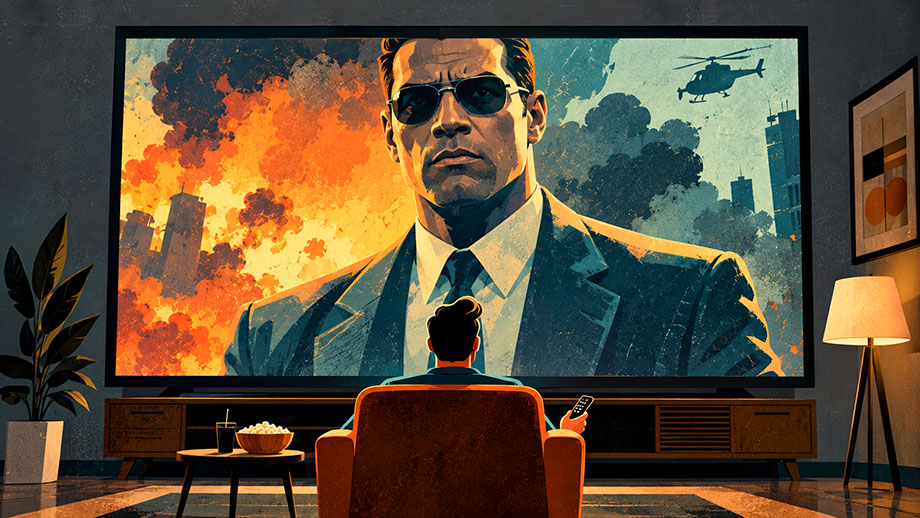
The woman was flabbergasted to discover that I don’t own a television.
“But what do you do every night after dinner?” she asked with a tone bordering on shock.
I explained that I spend most of my free time reading and thinking and writing — and I said that I also spend a good bit of time talking with friends. She seemed dubious, but said she could at least understand talking with friends.
She wanted to know how I watch streaming services in order to view the popular shows she listed. Everybody watches those. I told her I don’t watch any streaming services, so I’ve never seen any of the shows she mentioned.
She would have seemed less surprised if I had told her I spend my evenings in the basement making sacrifices to Baal. She struggled to respond, as though her mind couldn’t grasp what I was telling her.
“But that’s not normal,” she finally said. “Everybody watches the same shows. We all talk about them. Why don’t you just get a television? They’re cheap now. And you could be like the rest of us.”
I changed the subject, because it would have sounded too arrogant — from her point of view — if I had explained that the last thing I want is to be like her. I’ve spent years breaking free from the brainwashing of the “normal life” she loves so much.
I grew up watching television as much as I could.
I watched stupid shows. I watched serious shows. I watched ridiculous shows. I watched reruns of old sitcoms after school every day. And I never missed Star Trek reruns.
But my father limited my television time and there were limited choices back then about what I could see. We had three network channels and a public television station. Eventually, there were a few independent stations. And as cable television spread, there were more choices.
Still, there weren’t nearly as many choices as there are today. Between that and my father’s time limits, I found myself turning to something entirely different. I became a voracious reader. Over time, books dominated my leisure time. I still watched some television, but books formed the core of what mattered to me.
I read mysteries and adventure and science fiction. And then more and more science fiction. I got lost in worlds that were too complex — and required too much thinking — to ever work as television shows.
And that went a long way toward saving my mind.
It wasn’t until sometime in the 1990s that I discovered Neil Postman’s powerful book, “Amusing Ourselves to Death.” I wasn’t looking for something that would revolutionize my thinking or change the way I saw the world, but that’s what I found in the simple and logical reasoning from a brilliant NYU professor.
After I read Postman’s book, I stopped watching television. It wasn’t a gradual thing. I went cold turkey. Postman convinced me that my continued television viewing was bad for my intellectual health — and terrible for the health of our culture.
For a few weeks, it was difficult. If it was a Tuesday night or a Thursday night — or whenever else I might have watched certain shows before — I felt as though I was missing something.
And then something magical happened. As I got busy with other activities — things that were better for me — I soon forgot about all the things I had formerly planned my life around. What I discovered wasn’t that those shows I had spent so much time watching were evil or even poor quality.
What I discovered was that those entertaining shows had kept me from living a life that was far richer, both intellectually and artistically.
I’ve been begging people for more than 30 years to read Postman’s books. He has half a dozen books and all are eye-opening. I’ve read some of the more serious and intellectually challenging theoretical work that came before Postman, such as the work of Canadian media theorist Marshall McLuhan, who isn’t always easy to understand.
My intellectual and ethical values have moved further and further from those of the mainstream culture since then. Getting away from the routine media programming that I’d grown up with made it easier and easier to start seeing just how far off the rails my culture had gone.
But the further I got away from the dysfunction, the harder it was for me to understand why other people stayed with the entertainment brainwashing that had once seemed so normal to me.
I gradually felt more intellectually and spiritually free than I had ever felt, but I also felt more isolated than I’d ever felt. I felt like a man who had discovered that the keys to his cultural prison cell had been on the inside all along. And as I used those keys to escape, I was baffled that so few people were interested in finding the same intellectual and spiritual freedom I had found.
I don’t want to be like the self-important academic or the high-and-mighty culture snob. I really don’t. There’s nothing about what I’ve come to understand that makes me brilliant or special. I’m definitely no better than anybody else. I completely understand the allure of the amazing entertainment that our culture offers.
But I see that tradeoff for the trap that it is. I see it as someone who has escaped the trap, not as someone who was too smart or too sophisticated to live in the vast wasteland of popular culture.
Popular culture is dangerous not because it’s necessarily evil or low-brow. It’s dangerous because it’s beautiful and alluring and exciting. Mostly, it’s dangerous because of what it prevents its users from having the time and energy for.
I read and think and write in my free time, but it’s not because I’m brilliant. It’s not because I’m better than anybody else. It’s because I’ve come to understand my priorities differently.
Humans flourished and built an amazing civilization before electronic media ever existed. Our devotion to the culture of electronic media is slowly rendering more and more of us intellectually numb.
No single change has ever improved my life as much as eliminating television from my life. But because consuming popular electronic media seems so normal and necessary to most people, asking them to consider moving away from it is scary.
There is a life outside of television and social media and all the other things that your culture tells you to love. But until you get away from those things for a long while, you’ll have no understanding of the damage you’re doing to yourself by being addicted to popular culture.
 16-year-old charged with felony for science experiment gone bad
 Powerful emotions come and go, so it’s worth noting if one stays
 Nine years ago, he asked her, ‘Will you take a chance on me?’