• Skip to primary navigation
  • Skip to main content
  • Skip to primary sidebar
  • Skip to secondary sidebar

David McElroy

how we can choose moral beauty in a broken culture

  • About David
  • New here?
  • Reading
  • About AI
  • Moral Beauty

I helped communities connect; algorithms now pull them apart

By David McElroy · November 17, 2026

I used to be a newspaper editor.

This probably sounds quaint — almost comical — because a real newspaper editor is about as obsolete today as a typewriter repairman would be.

But this used to be a very big deal. Newspapers were incredibly important to their communities, especially in the smaller cities in which I worked. Television news was shallow and also had to cover a very wide regional area (or the entire country), but a newspaper could focus on the 10,000 people or 80,000 people of a local community.

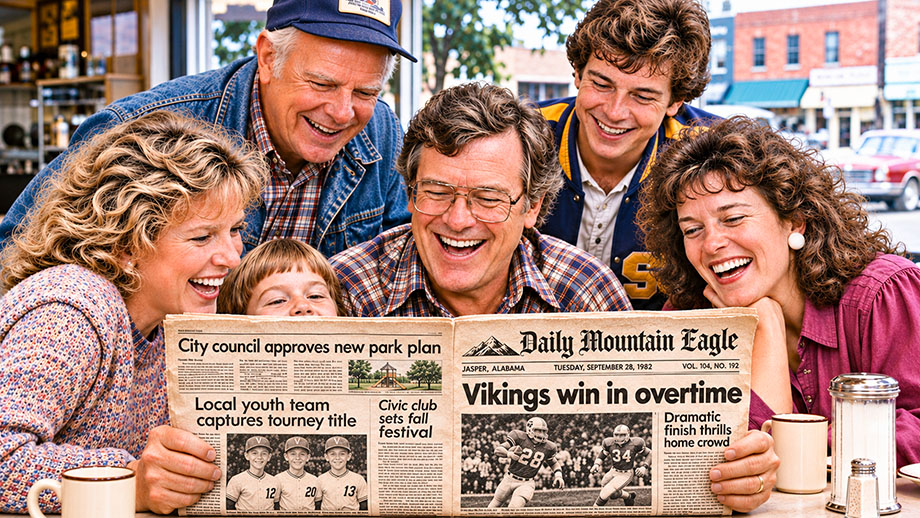
Very few people were ever going to appear on television news, but there was a very good chance that your name and picture — and the names and photos of people you knew — were going to show up in my newspaper. Those appearances were often going to be cut out and saved in scrapbooks.

Newspapers were important to their communities — and I loved my job. I saw what I did in terms that were almost mystical. For me, it was a sacred trust. I was there to be paid, of course, but I had a responsibility to serve the communities we covered. I took that responsibility very seriously.

I’ve been thinking lately that the skills I had as a newspaper editor are obsolete in modern media. I was very good at my job back then, but the skills and attitudes I had are useless in modern media. Even more so in social media.

We worked hard to serve everyone with one newspaper that went to everybody. All of our readers shared the same pages every day. That built a sense of community.

Online media and social media create a product just for you. If an algorithm decides you’re interested in left-handed ping pong players from China, your feed will suddenly be filled with the most narrow and trivial items about left-handed Chinese ping pong players.

My job as a newspaper editor was to cater to a wide community. We tried to interest as many people as possible. This meant that everyone was exposed to a wide variety of people and subjects.

A media algorithm today cares about none of that. It only pays attention to whatever you’ve shown you might pay attention to. It’s going to give you more and more of that — for as long as it works — because the only thing the algorithm cares about is whether you keep scrolling.

Have you ever noticed that your social media feeds — on Facebook, Instagram and other services — start filling up with more things related to whatever subjects you start paying attention to?

That’s the way algorithms work. We noticed that this person likes Star Trek, so we’re going to give him a million items related to Star Trek.

Or it might be one of a million other things. The algorithm doesn’t care what it is. It might be knitting. Or model trains. Or music from your high school years. It will give you whatever the software estimates will keep you scrolling.

What the software doesn’t care about is giving you a balanced media diet. It doesn’t care about community. It doesn’t care about sharing the accomplishments of your neighbors or friends, unless many dozens or hundreds of others also interact with those items in ways that suggest they would keep you scrolling mindlessly through the feed — and scrolling through the ads.

My skills as an editor aren’t relevant anymore, because I had to use judgment about what was best for my readership as a whole. I tried to get as many varied names and pictures of local people into the newspaper every day. I tried to cover as many subjects as I could.

We covered local schools, local businesses, local sports, local churches, local everything. We treated high school football and basketball games like the Super Bowl and March Madness. We ran church league softball scores and box scores. We ran lists of honor roll students from local schools.

If something was vaguely important to almost anybody in the community, it was made available to everybody.

“Did you see Billy’s picture in the paper?” a mother might ask her friends about her young son who hit a home run in a youth baseball game.

People turned to the newspaper regularly, because it was filled with the names and events and pictures of people they knew. We announced births. We ran pictures of children at their first birthday (for the parents who submitted the pictures). We announced engagements and weddings. We announced deaths.

And we didn’t charge people for those things. We had a sacred trust to share all of these things with everybody. And these things helped create a strong sense of community.

Major modern media — of all forms — care only about giving you narrow trivia that will keep you scrolling, so it dumps pictures and video of old trains or the Beatles or your favorite sports team.

And if there are headlines on those stories, the key facts will be withheld, because the real purpose of a headline today is to tease someone into clicking on the item. If a user clicks or taps on an item, a computer somewhere knows that a user was exposed to a particular ad — and that helps the media platform get paid.

When I first heard — many years ago — that future digital media would allow us all to have “customized newspapers,” I thought it sounded great. I thought it sounded amazing that we could all get a collection of the things that interested us — and avoid the things that didn’t interest us.

I was wrong. It’s not amazing. It’s dehumanizing. It leaves us segregated into smaller and smaller groups — and it leaves us knowing less and less about other people and other ideas.

If your feed is filled with items that cater just to your narrow interests — the things you already agree with and the things you already like — you’re going to be trapped more and more into an echo chamber in which everybody is almost like you. (And when you’re given something you don’t agree with, it will be designed to make you angry and cause you to react in a negative way.)

As we spend more and more time in these echo chambers, we stop noticing how little we’re seeing of the broader world. We’re fed a diet of things we love and things that will make us react angrily. We’re given only things that will keep us “engaged,” clicking “like” and posting comments.

We might feel as though we know everything about some narrow little thing, but we will know nothing of the broader world. We will never run across serious discussion of ideas that might challenge the things we already believe.

We will remain in narrower and narrower echo chambers — that isolate us in ignorance of anything except what the algorithm says will keep us scrolling.

This is why my skills are obsolete. I was trained — both in skills and in media culture — to build community and share the broadest information possible. The things I was taught are precisely the opposite of what modern media is trying to achieve.

We need the things that my newspapers used to bring to communities. We need something that brings communities together — something that makes everybody feel that he or she is a part of something much bigger than his or her own narrow interests.

But media algorithms are designed to deliver the opposite of that.

This is why my old newspaper editor skills are obsolete. And it’s why you are increasingly trapped in a narrow bubble that you might not even notice.

As someone who was fiercely devoted to the ideals of my craft and to the sacred feeling of serving my readers, I am depressed and hurt by this change.

But there’s not a thing I can do to put this digital genie back into its bottle.

Share on Social Networks

Related Posts

  • Existing biases dictate how you see grand jury decision in Ferguson, Mo.
  • If terrorists ‘hate us for our freedom,’ U.S. politicians are their best allies
  • Love & Hope — Episode 3:<br> The narcissist who taught me to feel shameLove & Hope — Episode 3:
    The narcissist who taught me to feel shame

Filed Under: Uncategorized

Primary Sidebar

Subscribe

Enter your address to receive notifications by email every time new articles are posted. Then click “Subscribe.”

Contact David

David likes email, but can’t reply to every message. I get a surprisingly large number of requests for relationship advice — seriously — but time doesn’t permit a response to all of them. (Sorry.)

Search

Archives

Donations

If you enjoy this site and want to help, click here. All donations are appreciated, no matter how large or small. (PayPal often doesn’t identify donors, so I might not be able to thank you directly.)


Future Photo Display

As part of my effort to rid my life of social media, I will no longer display links to my two Instagram accounts here. Those accounts will be dormant for the time being and will eventually be deleted. I plan to have a method for displaying photos here instead, but the solutions I’ve tested so far have been disappointing. I’m still working on it.

My Instagram

I always get frustrated when I take photos of the I always get frustrated when I take photos of the moon, but I always seem to come back to trying it again. When I was driving home tonight, I loved the way the moon looked with clouds tightly bunched around it, so I thought I’d make a quick picture and use it. Since the longest lens I have for my A7 is 240mm, I can’t get the resolution that I really need, So I end up trying all sorts of things in Photoshop that are really beyond my capabilities. This is better than what I started with, but it’s not what I might be able to get with an 800mm lens. I might be complaining about the results even if I had better equipment, though. At some point, I just have to accept that I should leave sky photos to photographers with better equipment and better skills. 😃
It’s too bad Meg can’t relax a little more, huh? I It’s too bad Meg can’t relax a little more, huh? I’m obviously kidding, because this little girl has quite a bit of confidence when she’s hanging out with me — and she has more confidence around the three boys every day, so that makes me happy. She’s been a great addition to the household.
By the time I left the office about 5:30 p.m. Frid By the time I left the office about 5:30 p.m. Friday, some light rain from the approaching hurricane was starting to fall. It’s been completely cloudy in Birmingham all day because of the bands of clouds pushing north from the Gulf of Mexico. About halfway home, I noticed that the sky had suddenly started exhibiting this beautiful orange glow to the west. So even though it was far too cloudy for us to see a real sunset, the light was still colorful enough and bright enough to punch through at the horizon. So I stopped on the Cahaba River bridge on I-459 and caught this quick shot. Within just a couple of minutes, the clouds had covered up the color — and the rain started getting a bit harder. By morning, we should have howling winds and serious thunderstorms. Let’s just hope there are no tornados spawned by this storm in our area.
I need some new portraits of myself, so I tried a I need some new portraits of myself, so I tried a few shots after I got home late Monday night. This one wasn’t great, so I’ll try again later, but I can use it until I have time to shoot another. I was too lazy to light this one properly — and it shows. 😺
Sunset, Leeds, Alabama — August 27, 2026 Sunset, Leeds, Alabama — August 27, 2026
Sunset, Leeds, Alabama — August 19, 2026 Sunset, Leeds, Alabama — August 19, 2026
When I got home at midnight Monday, I was doing so When I got home at midnight Monday, I was doing some work in the studio and Oliver wanted to join me, so I showed him around to acclimate him to the place again. He rarely goes in there, but I have pictures of him in that studio on the night I brought him home as a kitten. 😺
Earlier this week, I found two photos of Lucy and Earlier this week, I found two photos of Lucy and me that I had never seen. I loved finding the pictures, but seeing these photos left me thinking about the effect it has on us when we lose an animal we love — and it was also a reminder of how much my life has changed for the last nine months it’s been since I lost her. I wrote an essay about this. You can find it as the most recent post at davidmcelroy.org right now if you’re interested. I really do miss this sweet girl.
When I take lightning pictures, I’m always hoping When I take lightning pictures, I’m always hoping to get just one usable photo, but I got two dramatic images tonight. You might recognize the water tower and communication tower that you’ve seen in many of my sunset photos. This is about a mile from my house in Leeds, which is just east of Birmingham.
Follow on Instagram

Critter Instagram

From the CritterCam: Sam and Alex are napping on t From the CritterCam: Sam and Alex are napping on the heated pad  on chilly Monday evening.
Late Sunday night, Sam has been handling Neighborh Late Sunday night, Sam has been handling Neighborhood Watch duties in an office window. He is happy to report that the neighborhood is safe from criminals and ne’er-do-wells tonight. 😺
About 15 minutes after the most recent picture I p About 15 minutes after the most recent picture I posted of Meg — when I said she wasn’t in the mood for me to pick her up — she came loudly meowing to the bedroom and demanded to get into my lap. So I was wrong about what she wanted. 😺
At midnight, Meg is looking up through a hole abov At midnight, Meg is looking up through a hole above one of her caves on the castle. She let me rub her head — and she purred for me — but she wasn’t in the mood to be picked up, so she was curled up and ready to sleep again about 60 seconds after this.
Just a few minutes before sunset Saturday, Oliver Just a few minutes before sunset Saturday, Oliver was relaxing on the fireplace mantle as he continued the long wait for dinner time.
Oliver posed for me on the bed just a few minutes Oliver posed for me on the bed just a few minutes after midnight and I turned it into a moody portrait that’s designed to look like a studio portrait.
I just got home and found Alex struggling to stay I just got home and found Alex struggling to stay awake. I think he’s ready for all of us to get to sleep. 😺
Just before I left the house for a few hours, I la Just before I left the house for a few hours, I laid down on my bed to do a couple of things on my MacBook. Oliver thought that was his invitation to climb on top of me for a nap. I don’t think I’m legally allowed to move until he gets up. 😺
Meg is very dedicated to her Neighborhood Watch du Meg is very dedicated to her Neighborhood Watch duties Friday afternoon in an office window.
Follow on Instagram

Secondary Sidebar

Briefly

I’m seeing a lot of simplistic and dishonest explanations right now for the current rioting in France. Those on the populist far right claim it’s all about Muslim immigrants to France disrupting the culture. Their message is that this sort of thing is going to happen in the U.S. unless “we defend the border.” On the far left, socialists and their fellow travelers claim the riots are all about wealthy people in France not paying enough taxes, resulting in cuts to government services. The truth is far more complicated, but it’s rooted in the decline of population growth in Europe. There simply aren’t enough young workers paying into the tax system anymore, so cuts in social services were inevitable. There is genuine cultural tension as more and more people immigrate from other countries, but government cuts to education and other services are even more important to what’s happening. The situation is complicated, so don’t let dishonest people with U.S. political agendas tell you that it happens to support whatever they were already promoting for partisan reasons.

Here’s another reason to appreciate the cats in your life: New research involving 93 countries found that places with more cats per person also tended to have happier people. The researchers say the finding fits with previous evidence that living with pets can reduce loneliness and stress while providing companionship, emotional attachment and social support. The study doesn’t prove that cats cause greater happiness, but it certainly adds to the evidence that sharing your home — and your life — with a cat might be good for you.

The company that owns Facebook and Instagram is heavily promoting its new AI-based software assistant called Muse, but people who are using it as it was designed are incredibly foolish. An early adopter of the software discovered that a few days ago when he advertised an item for sale on Facebook Marketplace — and he inadvertently gave Muse full authority to act on his behalf. The software agreed to a lowball offer made by another Facebook user and then gave that man the home address of the man for whom he was an agent. The software told the buyer that the seller was home and waiting for him. When the buyer showed up and waited angrily, the would-be buyer left an angry review for the man. And this angry man had the seller’s home address. It was only well after that that the software reported what it had done and admitted it had made a mistake. I won’t be putting that much power into the hands of any software. I think anyone who agrees to such terms is a fool. And the software’s user agreement says you’re responsible for purchases the software makes in your name. Nope.

Meet my new girlfriend. Her name is Meg. And she’s my little sweetheart. A couple of months ago, a neighbor across the street told me about a new stray in the neighborhood that she and I were both soon feeding. The cat had been very skittish about contact and she had a lot of scabs and parasites in her fur, but a trip to the vet last week revealed that she was otherwise in good health. The vet estimates her to be 1 to 2 years old. I named her for Meg Murry, the 13-year-old protagonist of Madeleine L’Engle’s wonderful book, “A Wrinkle in Time.” (Please read the book. Don’t watch the horrible movie.) Since we lost Lucy almost a year ago, it seems appropriate that we finally have a new little girl to join the household. She’s already captured my heart, but Alex, Oliver and Sam aren’t there quite yet.

There’s nothing socially acceptable that’s as dangerous as drinking alcohol. Most people grow up being told to “drink responsibly” — and all of us see people abusing this drug in one way or another — but the truth is that drinking alcohol is always a terrible risk. The alcohol in these drinks is toxic and the human liver has to work hard to filter the toxins out. What most people don’t realize is that alcohol is classified as a known carcinogen by the World Health Organization — because of the well-established connection between imbibing and various cancers. Many people have taken refuge behind the idea that light or moderate drinking might be safe, but a new study shows that drinking even one drink a day increases the risks of 10 types of cancer. When I was a teen-ager, I looked around and saw the negative effects that this behavior had on a lot of people and decided not to start drinking, so I’ve never even tried this poison. The evidence keeps piling up that I was lucky to have come to that conclusion early.

Read More

Crass Capitalism

Before you buy anything from Amazon, please click on this link. I’ll get a tiny commission, but it won’t cost you a nickel extra. The cats will thank you. And so will I.

© 2011–2026 · All Rights Reserved
Built by: 1955 DESIGN