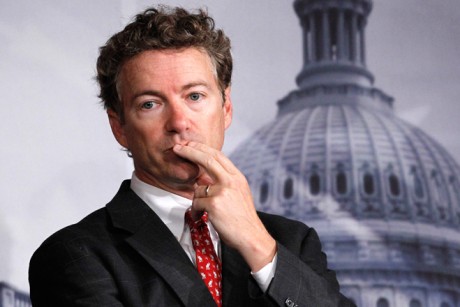
What does Rand Paul believe? Does he really know anymore? Or have his efforts at pragmatic compromise left him just as confused as the rest of us about who he really is?
For a long time, many people have believed that Rand Paul can’t be too much different from his uncompromising father. Ron Paul has preached a purist message for decades, as a Republican congressman, a Libertarian Party presidential candidate and then as a Republican presidential candidate. No matter how politically unpopular it was, Ron Paul could be counted on to be consistent — every single time.
How much different could his son be? He called himself a libertarian and he’s said many of the right things about reducing the size of government and about the virtues of making governance as close to local as possible. But ever since he entered GOP politics, he’s been ever more willing to say and do things to court the Republican mainstream and the party powers. Libertarians are now looking at him and wondering whether the man they saw as the heir to his father’s movement is one of them or if he’s really one of the people they’ve spent decades fighting.
 Without motivation, dreams fade,
 Was I ‘fat’? ‘Lazy’? My father’s ugly words made me feel shame
 The cesspool is deep and toxic, but I’m to blame if I remain there
 Appeals to ‘common sense’ are frequently excuses to avoid thinking
 Tired of Obama? Electing Romney or another Republican won’t help
 The Cain Train becomes train wreck when candidate has to think on feet
 If authentic connection is absent, we crave love and a human touch
 FRIDAY FUNNIES
 Homeless honor student thrown into jail for missing too much school