Those of us who’ve rejected the idea of a coercive state are frequently told that we need to be realistic and support government. Others tell us that we need to support “limited” government or “small” government. But what they never realize — and what we don’t point out often enough — is that they’re the starry-eyed idealists, not us.
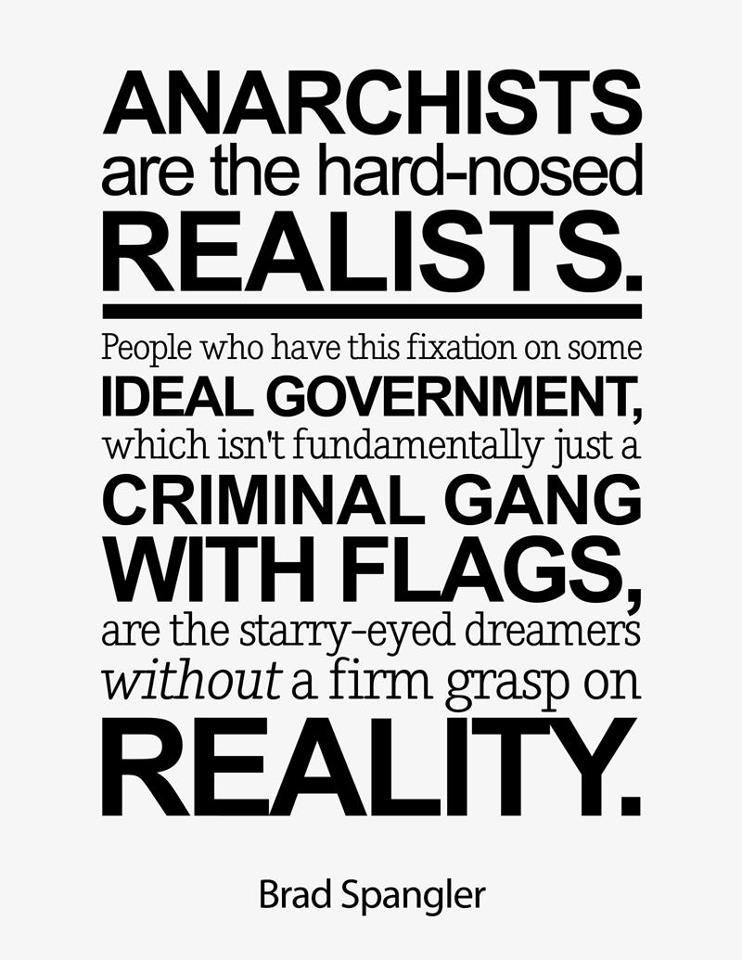
I came across a concise and excellent quote from Brad Spangler that we should all learn to say when statists tell us to be realists. Spangler is the director of the Center for a Stateless Society. Save the graphic here and make it into posters if you want. (Click on it for a larger size.)
“Anarchists are the hard-nosed realists. People who have this fixation on some ideal government, which isn’t fundamentally just a criminal gang with flags, are the starry-eyed dreamers without a firm grasp on reality.”
 In a culture that worships youth, we’re scared to look in a mirror
 Why did Republicans cheer the executioner of this innocent man?
 Join me Saturday for radio interview on KFAR-AM in Fairbanks, Alaska
 If an election can destroy your life, your priorities are out of whack
 Caine’s Arcade: Watch a 9-year-old boy have the best day of his life
 When you can’t call one you love, silent phone just taunts your need
 Getting better at all I do is only way to fight ‘imposter syndrome’
 Correcting an old error: there’s no such thing as ‘We the People’
 The child in me never learned to feel at home as part of a group