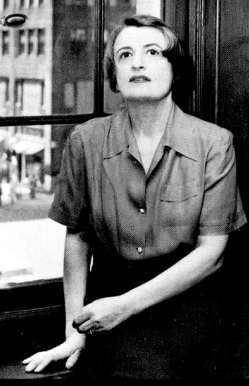
 If Ayn Rand knew how closely she has become identified with libertarians, she would be spinning in her grave. She loathed libertarians, calling them “hippies” of the New Right.
If you read her comments about libertarians — at the website of the Ayn Rand Institute — you quickly see that Rand didn’t understand any system that could do away with the coercive state. You also suspect that she was a bit jealous that libertarians were getting too much publicity, as she sniffed that they were “stealing” and “plagiarizing” some of her ideas.
I read several of Rand’s books before I ever heard the word “libertarian.” When I was about 14 or 15 years old, my father’s boss gave me a copy of “Anthem.” When I liked that, he recommended “The Fountainhead” and “Atlas Shrugged.” Her books introduced me to many new ideas, some of which I accepted and some of which I rejected. I consider reading those books important in my later political development, even though I reject the core of her philosophy.
And that’s one of the most interesting and complicated things about Rand. Almost everybody I know who has read her books has rejected her philosophy — which she called objectivism — but most of the readers of those books who went on to become libertarians or anarchists consider her work to have been an important step along the way, even though they did reject what was most important to her. How do we reconcile this seeming contradiction?
 Redemption of ’Bama’s Jalen Hurts illustrates what sports teach us
 Think ‘Tea Party’ will change D.C.? Do you remember the ‘New Right’
 Apple’s Steve Jobs is dead
 Abortion debate gives us lots of candidates for ‘Idiot of the Year’
 In cold and dehumanized culture, many yearn to feel human again
 Emotional health shapes reality of couple more than personality type
 Tell me the music you listen to and that’ll reveal a lot about you
 Why waste time on Ukraine war? Focus on your own future instead
 What did he have to lose? Man’s crazy tactic leads to romance