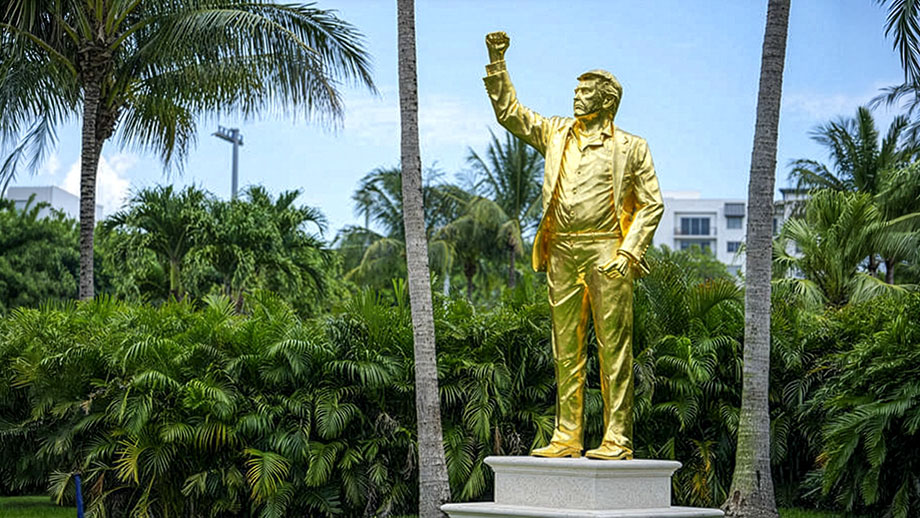
If a 22-foot-high golden statue of a narcissistic ruler doesn’t remind you of the golden calf, you probably aren’t very familiar with a certain story about the children of Israel in the Sinai desert.
And the people who endorsed this colossal monument to ego seem to think that if they keep saying, “It’s not a golden calf,” people will believe them. Sadly, many naive victims will do anything to avoid accepting that they’ve been snookered by a narcissistic con man.
I rarely talk about Donald Trump in a serious way anymore, but the recent unveiling of a golden statue of Trump — dedicated by Christian and Jewish clergy — was so outrageous that I had to try one more time. It’s painful to realize that many of my fellow Christians still haven’t accepted that their support of Trump is very much like the Israelites’ worship of a golden calf 3,500 years ago.
So I made a two-minute video late last night about this Trumpian “golden calf.” It’s embedded below.
In the video, I accidentally said the story of the golden calf was from about 1,500 years ago, but I was off by about 2,000 years. The story is actually said to have taken place about 3,500 years ago.
Fellow Christians, stop making excuses for this lying narcissist. This isn’t about ideology or politics. It’s about decency and core moral values.
 Genetics, culture work together to drive us to pursue what we want
 Friday’s article will be delayed
 For me, Valentine’s Day seems to bring out my regrets every year
 What do we prove with huge houses we can’t afford to pay for or even fill?
 When love finally dies, it’s like a fever breaks and the pain is gone
 Visit with high school best friend leaves me pondering my old fears
 I’m writing a book — and I’ll be talking about it as it progresses
 Muslims protecting Christian church remind us there’s good in all groups
 Let’s try a candid conversation just for the few who want to hear