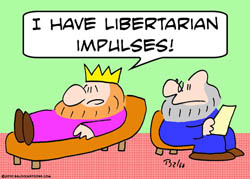
 What’s the difference between a libertarian and an anarchist? About 10 years.
It’s an old joke — and there are variations of it — but there’s some truth to it, because it’s a story that I’ve heard a number of times. In fact, it’s my story, too.
Most of us who’ve completely give up on the state started out in one of the mainstream political parties and then converted to the Libertarian Party, because we concluded that smaller government made sense and that there should be no distinction between economic and personal liberty. Republicans talk a good game about economic freedom, but they want to control your personal life. Democrats mostly talk a good game about personal (social) freedom, but they want to control your economic life. We see the contradiction of either of those positions, so we begin advocating the libertarian ideal of small government and freedom in all areas. For many of us, though, there’s a further step.
If you oppose government control on philosophical grounds, you soon run up against the issue of whether any form of the state can be morally justified. For many of us, we’ve reluctantly had to come to the conclusion that the state is immoral. Not just a “big state.” It applies to any state that claims the power to rule over the people and property that happens to fall within a certain geographical area — unless those people are there by their own choice and if they have other realistic choices.
 Assassin or patsy? How can you trust any of the players in this case?
 Intuition sometimes tells you when someone is worth chasing
 Federal debt default? So what? It happened before — in 1979
 We have no choice but to trust even in face of betrayal and hurt
 Epiphany: Was it so bad that I used to work toward perfection?
 Childhood programming trains us to wait for authority’s permission
 My friends stepped up in a big way when I needed their help for Bessie
 I like Ron Paul, but he’s not winning (and I don’t believe in the system)
 Genetics, culture work together to drive us to pursue what we want