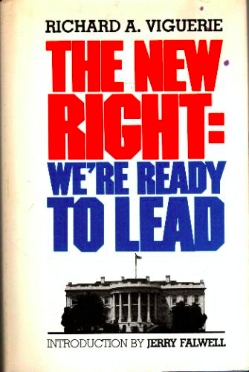
 You might remember a few of the names associated with the “New Right,” even if you don’t know much about them. Jerry Falwell. Ralph Reed. Richard Viguerie. Phyllis Schlafly. Pat Robertson.
These were names who were a big deal in the late ’70s and early ’80s as a new political movement rose up to challenge the Establishment in Washington and in the Republican Party across the country. They were socially conservative Christians and they were determined to change politics forever.
I still have a copy of Richard Viguerie’s 1981 book, “The New Right: We’re Ready to Lead.” (He was a brilliant pioneer of conservative direct mail fundraising.) I was a conservative Republican at the time and I was also a theologically conservative Christian, so it seemed natural to me that the two would come together in a powerful way and change politics.
I guess you could say that I was young and idealistic enough to be a True Believer.
I was only on the periphery of this movement, but I remember others who were convinced we were going to change the country in a positive way. We were passionately organizing and we were driven from the grass roots. We were disgusted with the cynical “politics as usual” that we got from government and even from our own Republican Party. There were so many of us involved that we were sure we were going to end the ability of the Establishment to continue running things as its members always had.
So what happened?
 Mundane expressions of love matter more than movie versions
 ‘Let’s Make a Deal’: How democracy is like a dumb old game show
 What if biggest risk to our lives comes from our own unhappiness?
 Archived audio of my Alaska radio interview available for download
 We now assume it’s normal, but time wasted commuting is nuts
 Overconfidence in financial models will lead to ruin in coming collapse
 THE McELROY ZOO: Meet Charlotte, the confident little girl
 Love & Hope — Update:
 To save my own sanity, it’s time for me to shut up about Trump