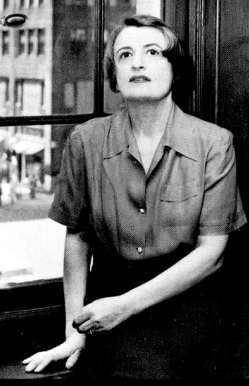
 If Ayn Rand knew how closely she has become identified with libertarians, she would be spinning in her grave. She loathed libertarians, calling them “hippies” of the New Right.
If you read her comments about libertarians — at the website of the Ayn Rand Institute — you quickly see that Rand didn’t understand any system that could do away with the coercive state. You also suspect that she was a bit jealous that libertarians were getting too much publicity, as she sniffed that they were “stealing” and “plagiarizing” some of her ideas.
I read several of Rand’s books before I ever heard the word “libertarian.” When I was about 14 or 15 years old, my father’s boss gave me a copy of “Anthem.” When I liked that, he recommended “The Fountainhead” and “Atlas Shrugged.” Her books introduced me to many new ideas, some of which I accepted and some of which I rejected. I consider reading those books important in my later political development, even though I reject the core of her philosophy.
And that’s one of the most interesting and complicated things about Rand. Almost everybody I know who has read her books has rejected her philosophy — which she called objectivism — but most of the readers of those books who went on to become libertarians or anarchists consider her work to have been an important step along the way, even though they did reject what was most important to her. How do we reconcile this seeming contradiction?
 Does every loss of love finally become a case of ‘sour grapes’?
 Storms can end without warning, bringing hope of blue skies ahead
 Why did we set things so that 70 percent of people hate their jobs?
 Pro-free market candidates don’t promise price targets on gasoline
 If you cherish the things you love, never take loved ones for granted
 How do we start over and give ourselves parenting we needed?
 Hermit life looks good as world tries to make me a misanthrope
 Take time to give honest praise, even when it’s just about a dog
 I’ve now launched a new podcast about search for love and family