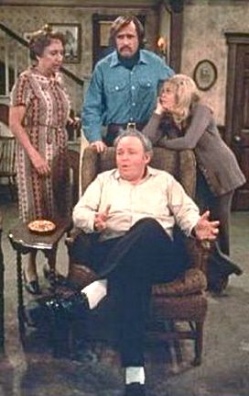
 What was the key to changing Americans’ attitudes toward race relations in the ’70s? Some would argue that it was political activism or congressional action or even street protests. I’d say that “All in the Family” was more important than any of those.
Do you remember “All in the Family”? If you lived through the ’70s, you probably saw it as a first-run sitcom. If you came along after that, you probably saw some episodes in syndication. After a shaky start — on a network with no real expectations for it — “All in the Family” took off to become the monster sitcom hit of the ’70s, with a long period during which it was No. 1 rated.
The show was about a lovable bigot and his family — his dim-witted wife who sometimes had the biggest heart and best insights, their ultra-liberal daughter and her even more liberal new husband. It might sound like a typical sitcom family, but the subjects were anything but typical. It confronted racial issues and bigotry (among other social issues) in a very up-front way.
The show was a success because it was funny. It was well-written and well-acted. It felt as though its biggest mission was to entertain, not to preach. And that is why it worked better than all the preaching in the world.
 Correcting an old error: there’s no such thing as ‘We the People’
 Tribal hatreds around me mean detour on road to personal peace
 Powerful emotions come and go, so it’s worth noting if one stays
 Not having someone to hope for differs from pain of missing love
 ‘Dad, is there really a Santa Claus?’ Should we lie to kids or tell truth?
 Sounds of old music awakened repressed feelings from my past
 Happy birthday to the monkeys; we’re marking two years today
 In winner-take-all systems, swing voters matter only at election time
 Love & Hope — Episode 14: