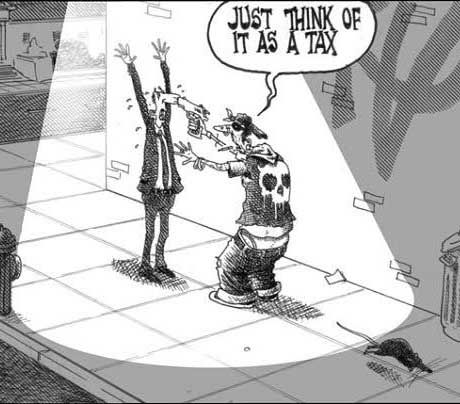
In light of the Supreme Court’s recent ruling concerning the individual mandate of ObamaCare, everybody’s getting into the act of redefining theft to be a tax. (Of course, taxes are theft, too, but that’s another subject.)
making sense of a dysfunctional culture
In light of the Supreme Court’s recent ruling concerning the individual mandate of ObamaCare, everybody’s getting into the act of redefining theft to be a tax. (Of course, taxes are theft, too, but that’s another subject.)

The woman seemed confused from the beginning. She was attending a one-day teacher workshop on middle school math education that was being conducted by a prestigious national organization. But she seemed completely lost when it came to actual math.
At one point, an exercise required simplifying a fraction. Hers was 16 over 20. She had no idea that it simplified to four-fifths. She was then supposed to convert that into a percentage. She not only didn’t know off the top of her head that it was 80 percent — which most people could do — she also didn’t understand when someone punched four divided by five into a calculator and showed her the results.
It’s pretty bad for a math teacher to be this ignorant of the very simple math she’s supposed to be teaching, but it’s actually worse. The woman was at this workshop because she’s writing a specialized math curriculum for her entire state. She works for her state’s department of education — and this woman who didn’t understand the basic material is about to write what all the kids are supposed to learn from.
Are you scared yet?

Why do I pay for 1,450 square feet of space to live in? I think about that frequently, and I don’t have a good answer. I live alone, with just the cats and a dog to keep me company. (They mostly hang out close to wherever I am.) I basically need a desk for my computer, a place to sleep and a bathroom. So why do I waste the money on space that could house four or five families in some parts of the world?
I’ve been thinking about this more and more lately. That makes it sound as though it’s just a rational thought, but it’s more than that. I’ve been feeling something I can only call a compulsion in my heart to get rid of almost everything I own and move to a much smaller place.
Do we really own the things we own? Or do they own us? I don’t have a tremendous amount of stuff — certainly not compared to most people I know — but the stuff I do have is making me feel weighed down. I don’t know why. I just know I don’t like it.
We live in a society with certain expectations of what’s acceptable, especially for those of us in the middle class or higher. We’re supposed to have a home that looks a certain way. We’re supposed to fill it with socially acceptable furniture. We’re supposed to care what other people think about what we have. We’re supposed to want the things that other people have. And most people believe they do want those things.
 Health risk and social costs make drinking alcohol a very poor risk
 Without community, we no longer know each other, in life or death
 Turn off the Outrage Machine; focus on things you can control
 Night of panic and little sleep shows chaos of finding my way
 Whatever you’re doing for Fourth, have a safe and happy holiday
 It’s wrong to silence anybody, even a nutcase like Alex Jones
 THE McELROY ZOO: Meet Thomas, the aloof loner of my menagerie
 Redefining words: Contrary to what you think, it’s not hostile to bomb cities and kill people
 What if I’ve fooled myself — and darkness is all that waits for me?