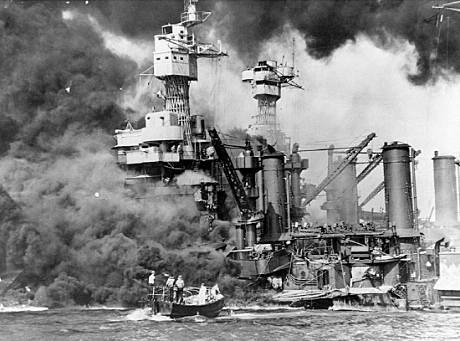
When I was growing up, I learned the standard Pearl Harbor attack story. The peaceful United States was minding its own business and staying out of the war raging in Europe when Japan suddenly attacked Pearl Harbor without any provocation. The Japanese were motivated simply by imperialist plans for conquest, we were assured.
I loved military history back then, and the war in the Pacific during World War II was my favorite. (If you ever want me to bore you with a detailed account of the Battle of Midway, I’ll be happy to do so, because it’s my favorite battle.) I have tremendous admiration for the people who fought that war and who sacrificed greatly in order to win it. Unfortunately, I can’t say the same thing about the political leaders whose actions led to the war.
When I was 12, I learned Franklin Roosevelt’s rousing speech on Dec. 8, 1941, asking Congress to declare war on Japan. (I can still do large parts of it, and I’m sure it’s funny to hear me emulate FDR’s accent.) I believed that Roosevelt was a great wartime leader.
 Being alone allows us to indulge our worst flaws and avoid change
 Fixing what’s broken inside often makes things worse until rebirth
 Great ideas are valuable, but they’re worthless without solid execution

 My need to make others perfect reflects my fear I’m not in control
 Minor killing is human nature, but massive slaughter requires states
 ‘How the Grinch Stole Christmas’

 We’re great at making big plans, but God laughs at our intentions
 People with healthy self-esteem don’t fear what others might see
 Dead man’s watch always there to remind me of my own mortality