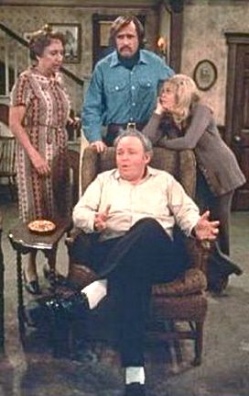
 What was the key to changing Americans’ attitudes toward race relations in the ’70s? Some would argue that it was political activism or congressional action or even street protests. I’d say that “All in the Family” was more important than any of those.
Do you remember “All in the Family”? If you lived through the ’70s, you probably saw it as a first-run sitcom. If you came along after that, you probably saw some episodes in syndication. After a shaky start — on a network with no real expectations for it — “All in the Family” took off to become the monster sitcom hit of the ’70s, with a long period during which it was No. 1 rated.
The show was about a lovable bigot and his family — his dim-witted wife who sometimes had the biggest heart and best insights, their ultra-liberal daughter and her even more liberal new husband. It might sound like a typical sitcom family, but the subjects were anything but typical. It confronted racial issues and bigotry (among other social issues) in a very up-front way.
The show as a success because it was funny. It was well-written and well-acted. It felt as though its biggest mission was to entertain, not to preach. And that is why it worked better than all the preaching in the world.
 Little boy for whom I was named shows what my mother hoped for
 As our heroes grow old and die, it’s a reminder of our mortality
 Theocracy? Secular liberty? Something else? Why not all of ’em?
 I can live without ‘Galt’s Gulch,’ but I need my ‘Akston’s diner’
 Nightmarish dreams mean dead can continue to play mind games
 We’re neither friends nor enemies, just strangers who share the past
 Trying to mold others to our image selfish, painful and doesn’t work
 Modern obsession with ‘hot girls’ teaches everybody to be shallow
 There are times we need to quit; what do you need to quit today?