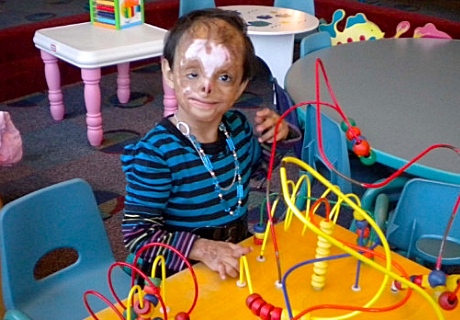
In 2009, three baby girls were among the victims of a missile attack launched on their village in Pakistan. They were badly burned and someone placed the three into a trash bin to die. A volunteer doctor from House of Charity found them and tried to save the little girls. Two of them died, but one of them, Shakira, lived. Barely.
Later the same year, Barack Obama was awarded the Nobel Peace Prize. What will Shakira think when she grows up and discovers that the man who was inexplicably lauded for being a peacemaker was also the man who unleashed terror on her and her village?
How can we live in a world insane enough to give a peace prize to the man who gives orders for missiles to destroy random sections of remote villages just because someone suspects a U.S. enemy might be there?
It was under George W. Bush that the drone program was launched, but it was under Obama that it was greatly expanded. The administration has recently admitted that U.S. policy basically says that if you’re in the vicinity of a terrorist, you must be a terrorist. Can you imagine if police used that standard for criminal cases here? If a criminal suspect is said to be in an office building, they’d just blow up the office building.
 Evil and idiocy stripping away veneer of western civilization
 Jobs created or saved by ARRA stimulus? Much of it was pure fiction
 Super Suckers: Indy taxpayers take bath in red ink to build stadium
 ObamaCare must fail in long term, but conservatives can’t stop it now
 W.V. student suspended from school and arrested for pro-gun t-shirt
 For power-hungry politicos, nothing is more important than winning
 Galt’s Gulch? I can live without that, but I need my own ‘Akston’s diner’
 Sad husband: ‘My beautiful wife is dying; I’m so sad I can’t sleep’
 I am angry that life doesn’t work the way I once learned it should


