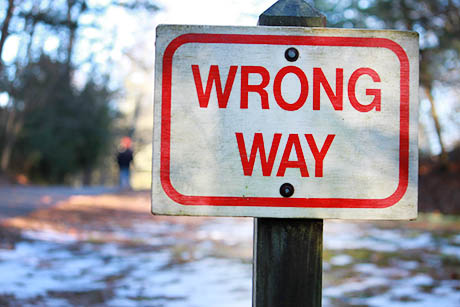
Most people are afraid to turn around when they’ve made a choice they’ve determined to be wrong. If they turn the wrong way down a road — confidently declaring it to be the way to go — they persist with the error long after it’s obvious.
We humans hate admitting we’re wrong.
We trap ourselves with our desire to be consistent, even if we don’t consciously know what we’re doing. Most of us are terrified of being seen as contradictory, so we’re afraid to reverse course and say, “I know I said X, but I was wrong and I’ve realized Y is the truth.”
Most people keep themselves locked into X long after they’ve realized Y is true, because they’re too weak to admit to having been wrong and forthrightly turn around. This is what Ralph Waldo Emerson meant in a widely misunderstood passage in his 1841 essay on “Self-Reliance.”
 After 50 years of being alone and disappointed, boy finally gets girl
 When it comes to politics and race, double standards are everywhere
 How many warnings can life give us when something’s gone wrong?
 Ghost from my past haunts me, but leaves me without answers
 Slow culture changes might mean skin color matters less in future
 Don’t show me the past or the future; show me what you can give now
 No matter what it is you believe in, some form of faith is at the root
 What’s your goal? Do you want to blow off steam or find solutions?
 Meet the new neighbors: Why rules aren’t always such a bad thing