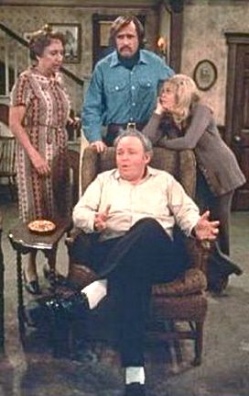
 What was the key to changing Americans’ attitudes toward race relations in the ’70s? Some would argue that it was political activism or congressional action or even street protests. I’d say that “All in the Family” was more important than any of those.
Do you remember “All in the Family”? If you lived through the ’70s, you probably saw it as a first-run sitcom. If you came along after that, you probably saw some episodes in syndication. After a shaky start — on a network with no real expectations for it — “All in the Family” took off to become the monster sitcom hit of the ’70s, with a long period during which it was No. 1 rated.
The show was about a lovable bigot and his family — his dim-witted wife who sometimes had the biggest heart and best insights, their ultra-liberal daughter and her even more liberal new husband. It might sound like a typical sitcom family, but the subjects were anything but typical. It confronted racial issues and bigotry (among other social issues) in a very up-front way.
The show as a success because it was funny. It was well-written and well-acted. It felt as though its biggest mission was to entertain, not to preach. And that is why it worked better than all the preaching in the world.
 Jesse Jackson Jr. demands Obama hire 15 million unemployed Americans
 Friend’s happy family and career remind me how good life can be
 Collective freak-out over tasteless shirt points to double standard
 Tough problem: What does a free society do about unfit parents?
 When doubt wakes me at dawn, my world seems a lonely place
 No matter where I might ever live, the South will always be my home
 Ignore the happy face it presents: Coercive state points a gun at you
 Social media creates shallow ties at expense of deeper connections
 I don’t claim to know the solution, but the modern church has failed