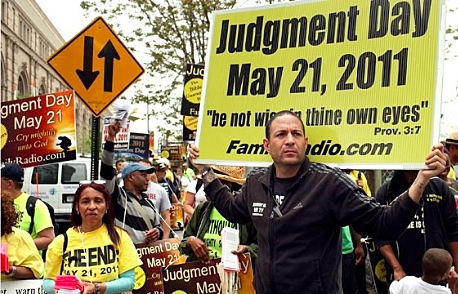
It was a year ago today that the world was supposed to end, according to California radio preacher Harold Camping. Of course, when it didn’t happen, he suddenly found new evidence in scripture to support his revised calculations and said the end would come five months later. That date also passed without the world ending.
It’s easy to make fun of a nut such as Camping — and I did my share last year — but there’s a lesson here for anyone who’s so certain of the accuracy of his own beliefs and predictions: Any of us can be wrong. Certainty doesn’t make a person right — and dogged determination to stick to a prediction or position might just mean the person is arrogant and stubborn. (Unfortunately, strident confidence in error is rewarded in politics, while thoughtful candor is punished.)
How did Camping and his followers go so wrong? I’ll never know. Anyone who knows the Bible know that there’s nothing there to make a reasonable person believe he can predict the end of the world. Anyone who tries is simply bringing his own assumptions (and his own arrogance) to bear in order to come up with a date that isn’t there. (If you want to get a heated argument going, ask people from certain Christian groups to get together and compare notes about what’s going to happen when the world ends. Then hide the breakables and get out of the way.)
On the rare occasions when I could get away with disagreeing with my father when I was a kid, he would tend to say, “Well, you just think you’re right.” That statement always puzzled me. Obviously I thought I was right or I wouldn’t hold whatever position I held. Isn’t that true for all of us?
 Wall Street protester accidentally illustrates power of voluntary action
 Beth’s husband loves alcohol more than he loves her, so he left her
 Trusting Obama to create jobs is like trusting an arsonist to put out fires
 Sorry, Hillary: Research shows it doesn’t take a village to raise a kid
 Let others be wrong if they want; it’s not your job to fix their errors
 Whether it makes sense or not, I’ve learned to expect miracles
 Loving father’s pride in daughter easily bridges our language gap
 If we always beat ourselves up, how will we ever heal and grow?