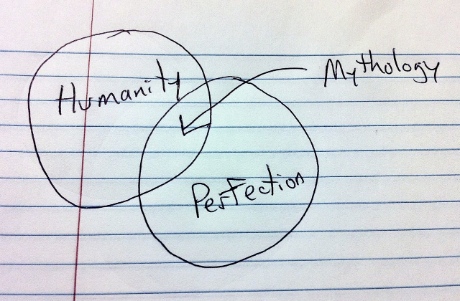
Over the past couple of years, I’ve come to appreciate flaws and imperfections in a way that I never did before, especially in people. I confused someone a couple of nights ago by saying that, so it’s forced me to figure out how to explain this counterintuitive notion.
For years, I’ve had the intellectual belief that life is a series of tradeoffs. If you get something positive in one area, you give up something in another part of life. Ralph Waldo Emerson’s essay on “Compensation” influenced me a lot about this subject about 15 years ago. He argued that there’s a natural process that balances everything. I don’t buy everything about Emerson’s philosophy, but I’ve found a lot of truth in this particular idea.
It seems to me that people with great talents and gifts will always have compensating weaknesses, although the positive things sometimes make it hard to notice the negatives. Those who have terrible flaws will almost always have compensating strengths or advantages, even if they’re sometimes hidden by the obvious flaws.
So I recognized — in theory — that great strengths are always going to come with great flaws as compensation. What I didn’t realize until fairly recently was that I had a different standard for certain others close to me. (And for myself.) With certain people, I was expecting incredible strengths and impressive attributes to come with no downsides. So when I found someone amazingly impressive, I put that person onto a pedestal — a place where no one can stay for long.
 Choose the person you don’t want to spend your life without
 My mother was more impressive than my father led me to believe
 Voting Rights Act oversight rules should reflect today, not the past
 Would you have been on a ship? Or back home complaining?
 As Christmas gets closer, I miss the joy I felt for Christmas trees
 No ebooks for me: Reading is about more than simply absorbing data
 Art and culture are keys to winning the future for individual liberty
 THE McELROY ZOO: Meet Molly, the cat who was ‘returned to sender’
 AUDIO: Now is a time to take risk, not the time to be stopped by fear