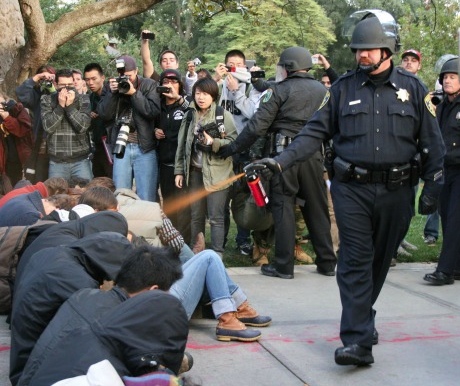
You’ve probably seen this picture or seen video of the same scene. Campus police at the University of California at Davis blasted pepper spray at peaceful student protesters Friday. Many people are outraged. Many are calling for the firing of the officers. I’d like to step back and take a broader perspective with three points.
First, this incident proves again that photography matters. In many places, police arrest people for taking pictures of them doing their jobs. In some places, it’s even specifically against the law. The attempts of police, politicians and prosecutors in some places to stop photography of them are wrong, whether it’s through arrests or intimidation.
If the pictures and video from the UC-Davis incident didn’t exist, this would be a non-story. We wouldn’t be talking about the issue. It would be almost as though it didn’t happen. This is why it’s important to strongly press the case that photography is not a crime. (You’ll find plenty of stories at that site of police and other public officials attempting to stop photography that they don’t like.)
Second, these sorts of incidents — and far worse — go on almost every day, but we don’t know about them because there is such a strong “support the police” culture in this country. The people who are experiencing oppression, threats and intimidation from police are mostly those who are powerless to do anything about it. They tend to be poor, black, brown or undereducated. They tend to be people who either don’t know their rights or know they won’t be believed if they complain.
 One college senior explains financial facts to the Wall Street protesters
 Unless you’re suicidal, an armed march on D.C. is a very bad idea
 Spiritual truth can be felt by heart, but not always understood by brain
 Short story: ‘Hello From the Past’
 Nothing new here: Russell Brand pushing same old socialist idiocy
 Nature made me like my mother, but my father tried to erase that
 Emotional health shapes reality of couple more than personality type
 If ‘bigots’ can lose their rights, will your rights be next to go?
 At life’s end, who we’ve loved will matter more than what we’ve owned