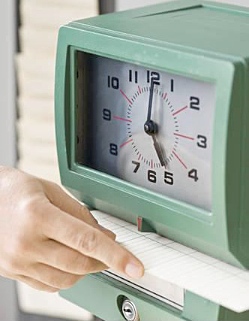
 When I started work as a newspaper reporter many years ago, I had to clock in and out every day if I expected to be paid. Just like many millions of people, I was paid for my time, not my output. I never understood why.
When I was a teen-ager and first started cutting lawns to make money, I quickly discovered that people wanted to pay me an hourly rate. I used to gently push for a different arrangement. I wanted a flat fee for the service, because I felt that the hourly rate punished me for working harder and faster. Sometimes my clients agreed, but many held out for an hourly rate, so I was stuck having to make sure I didn’t work too fast and thus cheat myself. I hated it.
The obsession with paying people for their time is a relic of the industrial age, when human labor was considered just another interchangeable part of an industrial machine. (The idea that any hour of labor should have the same worth as another hour of labor was also an important cornerstone of Karl Marx’s thought.) The idea might have made sense in an age when people were treated like gears in machines. It has no place in a world where brains are more valuable than brawn.
I came across software today that is something like a modern version of the time clock for people who work for companies from home or other locations. The software is called Odesk. It’s installed on your computer and it takes screenshots of whatever you’re doing at six times each hour. It records the movement of your mouse. It can even record keystrokes to figure out what you’re doing. If your six screenshots show work apparently taking place, you get paid. If one of your screenshots shows something other than work, you give up one-sixth of your hour’s pay.
 Starting over is sign of strength, not a plea of weakness or failure
 ‘Self government’ means you govern yourself, not obey your neighbors
 If you’re driven to create beauty, you’re an artist — like it or not
 Paradox of choice can leave us longing for certainty of the past
 God watches humanity’s struggle and says, ‘You’re doing it wrong’
 I love my iPad, but I suspect that books are better for ‘deeper’ learning
 Poll shows half of Occupy Wall Street crowd favored Wall Street bailout
 A year later, late-night phone call and suicide threat still echo in me