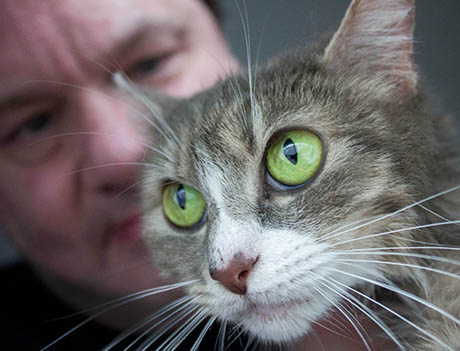
Although Bessie has lived inside with me for more than seven years, she’s still a wild, untamed and terrified little cat — just as she was when I brought her in from the cold on a freezing December night years ago.
Bessie and her sister, Molly, had lived on the streets around my house with their mother. They were a few months old when their mother suddenly disappeared. I took them in with the assumption that I could teach them to trust humans if they were loved and cared for. After all, I had done that repeatedly with other cats who had turned into loving companions.
But Bessie and Molly never learned to trust. They enjoy food and a safe place to sleep and live, but they have never accepted that it’s safe for me to touch them. Something in their feral genes or their early life on the street has taught them that humans aren’t to be trusted. So I just accepted long ago that I could give them a safe place to live but that they would never want human love.
In the last month, I’ve had reason to think I might have been mistaken. Maybe with even more time and work and love, Bessie might change.
Nearly a month ago, I had to catch Bessie to shave some mats out of her fur. She had gotten something into the fur of her back and she hadn’t been able to clean it out, so it had matted. She has only three legs, so it’s harder for her to clean some parts of herself than it is for other cats.
 Why do we often attract the folks who are most destructive for us?
 I like Ron Paul, but he’s not winning (and I don’t believe in the system)
 Random stats after five months
 Joseph Kony is evil man, but don’t let yourself be ‘guilted’ into war
 Donald Trump is no conservative; he’s an immoral, narcissistic liar
 Our inexplicable behavior ‘signals’ to the world who and what we are
 What if our best romantic decisions come by listening to ‘selfish genes’?
 Making the ‘right’ enemies shouldn’t make a politician electable
 Nature made me like my mother, but my father tried to erase that